Qualifying Income Over £30,000? MTD Starts 6 April 2027
Published
6 min read

You let two flats and invoice some freelance work on the side. Your 2025 to 2026 tax return will show £19,000 of rent and £14,000 of self-employment income. Together that is £33,000, and it puts you into Making Tax Digital from 6 April 2027.
From that date, MTD for Income Tax covers landlords and sole traders whose qualifying income for 2025 to 2026 was over £30,000. Qualifying income is gross rent plus self-employment turnover, before expenses. You keep digital records, send a quarterly update every three months and file your tax return from MTD software. The first update is due on 7 August 2027.
Landlords with one to three homes on Lendlord record a median rent of £1,000 a month per home (31 October 2026). Three such homes take one owner past £30,000 on rent alone.
Thresholds, dates and penalties checked on 18 November 2026 against GOV.UK's MTD guidance and the Budget 2026 document. Rent figures from Lendlord accounts approved for disclosure, snapshot 31 October 2026.
Are you over the line? The test HMRC runs
HMRC does not test this year's income. For the £30,000 step it reads your 2025 to 2026 return, due by 31 January 2027. That year ended on 5 April 2026, so the figures that set your start date are already in your bank statements.
Add up the gross figures, before costs or mortgage interest:
- Counts: property rent and self-employment turnover.
- Your share only: on a jointly owned home, only your share of the rent.
- Does not count: PAYE wages, pensions, dividends and partnership profit.
- Not in MTD for Income Tax: homes held in a limited company.
HMRC writes when your return shows income over the line, but no letter does not mean you are out. Its MTD start date checker gives your date. Landlords who cannot use digital tools can apply to HMRC for an exemption.
MTD Hub
Connect to HMRC before your first quarter starts
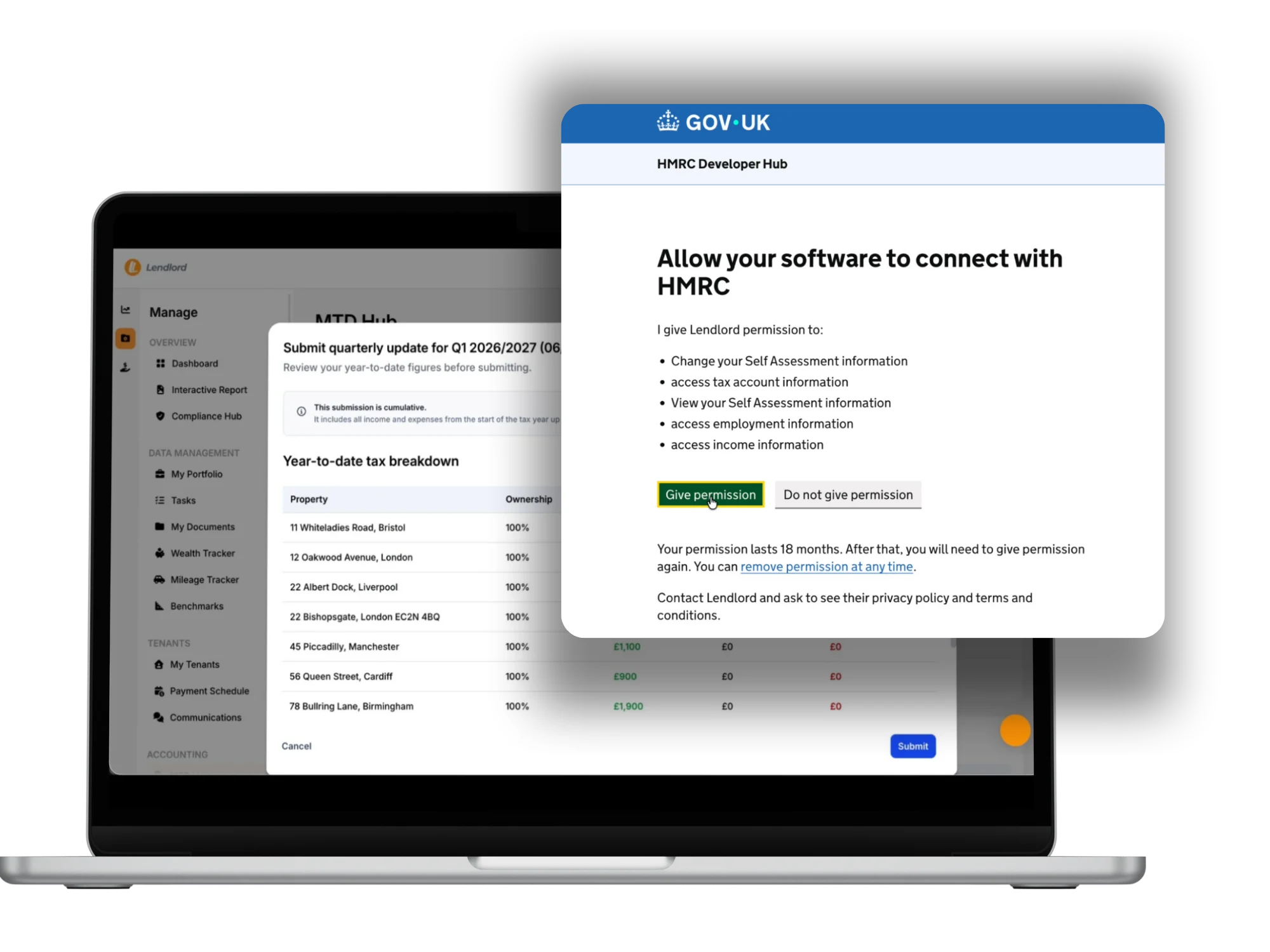
Authorise Lendlord with HMRC, keep digital records from day one, and send each update from one account.
Set up the MTD Hub freeHow many homes it takes at typical rents
The line sits lower than most small landlords expect. At the £1,000 median for landlords with one to three homes, two homes bring in £24,000 a year and three bring in £36,000.
Rents spread widely in that group. At the lower quartile, £750 a month, three homes make £27,000 and stay under. At the upper quartile, £1,500, two homes already make £36,000.
| Region | Median rent a month | Rent a year per home | Homes to pass £30,000 | Homes to pass £20,000 |
|---|---|---|---|---|
| Greater London | £1,850 | £22,200 | 2 | 1 |
| South East | £1,390 | £16,680 | 2 | 2 |
| South West | £1,213 | £14,556 | 3 | 2 |
| East of England | £1,200 | £14,400 | 3 | 2 |
| West Midlands | £995 | £11,940 | 3 | 2 |
| East Midlands | £900 | £10,800 | 3 | 2 |
| North West | £850 | £10,200 | 3 | 2 |
| Scotland | £800 | £9,600 | 4 | 3 |
| Wales | £800 | £9,600 | 4 | 3 |
| Yorkshire and the Humber | £795 | £9,540 | 4 | 3 |
| North East | £678 | £8,136 | 4 | 3 |
Source: Lendlord accounts approved for disclosure, snapshot 31 October 2026. Median recorded rent per let home, landlords with one to three homes. Northern Ireland is left out: the group there is small.
Read your row as a prompt, not a verdict. In London and the South East, two homes at a typical rent pass £30,000. In the North East, Scotland, Wales and Yorkshire it takes four. The margin can be fine: two South West homes at £1,213 make £29,112.
For landlords already above the first line, see Lendlord's findings at the £50,000 threshold.
Recorded rent is what landlords enter for each let home on Lendlord, before costs. It is not HMRC qualifying income: it leaves out self-employment, is not split for joint owners and may include company-held homes.
Two London homes, owned 50:50
Two homes at the London median of £1,850 a month bring in £44,400 a year. A couple who own both equally have £22,200 each.
Neither is over £30,000, so neither starts on 6 April 2027. Both are over £20,000, so if their 2026 to 2027 rent is similar, both start on 6 April 2028.
Worked example on the London median. Your share and any self-employment income decide your own date.
What to set up before 6 April 2027
Do the steps that wait on HMRC first. A lost Government Gateway login or an old address on your tax record can hold up sign-up.
- File your 2025 to 2026 return by 31 January 2027 and check the gross rent and turnover. That return sets your start date.
- Choose software that works with MTD from HMRC's MTD software finder. Lendlord is HMRC-recognised Making Tax Digital software.
- Sign up with HMRC. You need Self Assessment registration and a return sent in the last two years. You can sign up now for 2027 to 2028.
- Pick standard or calendar update periods before the first update. You cannot switch for the rest of that year.
- Start digital records from 6 April, property by property, with mortgage interest in its own category.
- Joint owners each sign up for their own share, and choose whether updates carry income only or income and expenses.
- If an accountant files for you, agree who sends each update.
Your 2026 to 2027 return still goes in the usual way, by 31 January 2028. Volunteering for 2026 to 2027 means sending the missed updates for the year so far, so signing up for 2027 to 2028 is usually the cleaner route.
John Noble on getting ready for MTD
Your first deadlines as an April 2027 joiner
Each update is cumulative: it carries the tax year so far, from 6 April. A quarter with no rent and no costs still needs an update.
| Update | Year to date, up to | Send by |
|---|---|---|
| First quarterly update | 5 July 2027 | 7 August 2027 |
| Second quarterly update | 5 October 2027 | 7 November 2027 |
| Third quarterly update | 5 January 2028 | 7 February 2028 |
| Fourth quarterly update | 5 April 2028 | 7 May 2028 |
| Tax return (Final Declaration) | The whole 2027 to 2028 tax year | 31 January 2029 |
Calendar periods end on the last day of the month, with the same send-by dates. The first group shows why 7 August matters: about half of the £50,000 group had not sent their first update when HMRC counted in August 2026. For each screen of a submission, use the MTD Hub walkthrough, slide by slide.
The first-year easement covers less than it sounds
Budget 2026, on 28 October 2026, gave April 2027 joiners the soft landing the first group had: no penalty points for late submission of your first four 2027 to 2028 quarterly updates. Three things still apply:
- The updates are compulsory. The easement does not remove them.
- Late returns and late tax cost money. A late tax return earns one penalty point. In the first year, there is no late payment penalty if you pay in full, or agree a payment plan, within 30 days of the due date. If you volunteered before you had to join, that window stays at 15 days. For 2027 to 2028, the rates are 4% of the tax still owed at day 15, 4% at day 30, and 10% a year from day 31.
- Quarterly points start in 2028 to 2029. Four points bring a £200 penalty.
For this group the points are a 2028 problem; the habit is a 2027 one. Diary the 7th of August, November, February and May. The same tax year brings the planned rise in property income tax rates, so read the tax estimate after each update.
Set up the HMRC link and your property records before 6 April, then send your first update by 7 August 2027.
Start your MTD records free
Expert insight from John Noble, Qualified Accountant and Property Tax Strategist · Guest contributor · Founder, Noble One Accountants · Last updated November 2026
John's rule for anyone close to the line: if your 2025 to 2026 gross figures sit just under £30,000, set up as if you were in. The £20,000 line a year later will most likely catch you, and a practice year costs less than a rushed first quarter.