Property Income Tax Rises 4 Points From April 2027: About £306 a Year on a Typical Rented Home
Published
6 min read
On a typical privately owned home in Lendlord accounts approved for disclosure, gross cash flow after mortgage payments is £637 a month. Four points of tax on that is £306 a year. Budget 2026's own two points are £153 of that. Snapshot 31 October 2026.
Budget 2026, on 28 October 2026, announced property income rates of 24%, 44% and 49% from 6 April 2027. The rates are in Finance Bill 2026-27. They are not law yet. The pounds below are an illustration, worked on gross cash flow before running costs.
Figures from Lendlord accounts approved for disclosure, snapshot 31 October 2026. Rates from the HMRC policy paper of 29 October 2026. Legislation is in Finance Bill 2026-27.
What changes on 6 April 2027
The ordinary income tax rates stay at 20%, 40% and 45%. Property income was already due a separate rate. Budget 2025 set that plan at 22%, 42% and 47%. Budget 2026 announces a further two points, to 24%, 44% and 49%.
This is for individuals and partnerships in England and Wales, and in Northern Ireland. Companies are outside this income tax change. Scotland sets its own property income rates.
| Band | Ordinary rate | Budget 2025 plan | Announced for 2027 |
|---|---|---|---|
| Basic | 20% | 22% | 24% |
| Higher | 40% | 42% | 44% |
| Additional | 45% | 47% | 49% |
The personal allowance stays at £12,570. The higher-rate threshold stays at £50,270. The four-point gap is the same at each band, so the per-home pounds do not change with the band while the profit stays inside one band. The first two-point step from Budget 2025 is the move from the ordinary rate to the 22% plan.
Four points on a typical rented home
One home, two bases
On a £637 monthly cash flow, the sum is £637 times 12 times 4%, which is £306 a year. Of that, Budget 2026's two points are £153. The same four points on the median rent of £911, with no mortgage and no costs taken off, come to £437. That rent figure is a ceiling, not a typical bill.
Gross cash flow here is rent less mortgage payments. It is not taxable profit. Running costs, vacancies and other income are still to come off.
Your own homes
Use the rent and the mortgage you actually collect
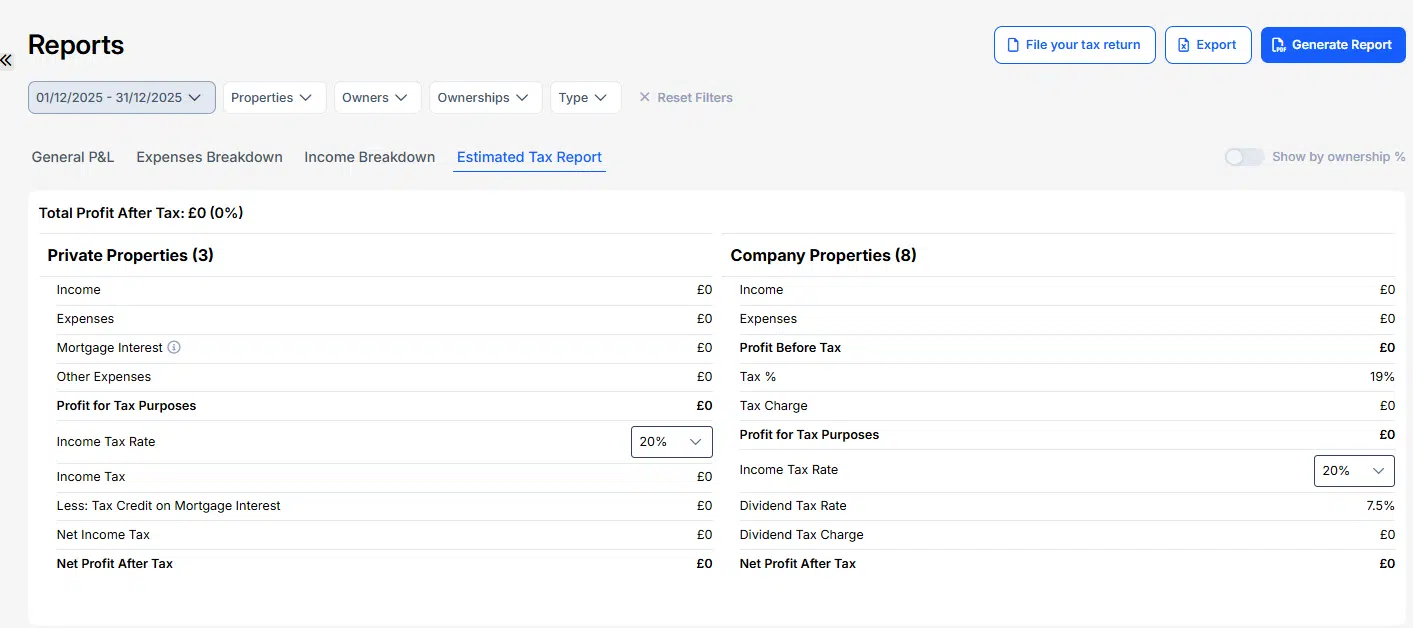
The £306 uses a median. Your cash flow, your costs and your band decide the tax.
Track rent and costsRegion by region
Each row is privately owned homes. Northern Ireland holds 0.9% of them, so that row is thinner. On a phone, read cash flow and the four-point column.
| Region | Share of homes | Median rent | Cash flow | Four points | Of which two points |
|---|---|---|---|---|---|
| UK, private homes | 100% | £911 | £637 | £306 | £153 |
| Greater London | 13.0% | £1,800 | £1,205 | £578 | £289 |
| South East | 7.5% | £1,250 | £811 | £389 | £195 |
| East of England | 7.3% | £975 | £725 | £348 | £174 |
| South West | 4.0% | £1,100 | £741 | £356 | £178 |
| West Midlands | 6.9% | £900 | £599 | £288 | £144 |
| East Midlands | 4.2% | £850 | £540 | £259 | £130 |
| North West | 13.4% | £850 | £585 | £281 | £140 |
| Yorkshire and the Humber | 7.6% | £725 | £495 | £238 | £119 |
| Wales | 2.4% | £795 | £493 | £237 | £118 |
| North East | 5.1% | £635 | £437 | £210 | £105 |
| Northern Ireland | 0.9% | £725 | £529 | £254 | £127 |
Greater London's extra is £578 a year on a £1,205 cash flow. The North East's is £210 on £437.
HMRC's policy paper expects around 5% of taxpayers to pay an average £225 more in 2027 to 2028 from the two-point step. That is per taxpayer, not per home. HMRC puts them at 2.4 million landlords by 2031. Budget 2026 expects £35m in 2027 to 2028 and £575m in 2028 to 2029.
Does portfolio size change the pounds?
Homes in a portfolio of 1 to 3 are 28.7% of this snapshot. Their median cash flow is £675 and the extra is £324. On 4 to 10 (27.8% of homes), cash flow is £576 and the extra is £276. A mid-size band (17.3%) shows cash flow of £592 and an extra of £284. The largest band (26.3%) shows £600 and £288.
These bands mix company homes, so they are not a private-only bill.
Platinum Property Academy, which runs portfolio teaching and uses Lendlord, wrote:
…Lendlord fixes that. It brings sourcing, analysis, cash flow tracking and tenancy management all into one place.Platinum Property Academy, Instagram, 27 Feb 2026
View this post on Instagram
Check the £637 example against the rent and mortgage on one of your homes.
Records before the April 2027 rates
Why company-owned homes sit outside it
Of the homes in this snapshot, 35.4% are held in companies and 64.6% are private. Companies pay corporation tax on their profits. They are not charged these property income rates.
Incorporation has its own tax costs. Speak to an accountant before you restructure. If a sale is being weighed, that is a different tax from this income-rate change.

What the finance-cost credit does here
The finance-cost credit is given at the property basic rate, as the November 2025 technical note describes it. No Budget 2026 document sets a new percentage for that credit. When the credit moves with the property basic rate, cash flow after mortgage payments is the closer base for this illustration.
The illustration cannot see running costs, a band crossing at £50,270, other income, or the limits on the credit. What your portfolio clears after costs is a different sum. Run your whole tax position through the bands for the allowances.
What to check before April 2027
Before you treat £306 as your figure
Work from your records. The median is only a starting point.
- Note whether each home is in your name, joint names, or a company.
- Take one year's rent and subtract the mortgage payments.
- Take off running costs before you call the result profit.
- Multiply that profit by 4% for a four-point illustration.
- Check whether the extra pushes total income across £50,270.
- Keep finance costs in their own column for the credit.
- Book an accountant if a restructure is even a possibility.
Limesh Joshi, who uses the portal to track income and expenses, wrote in a review on Trustpilot:
…offers a suite of tools that make tracking income, expenses, and performance easy and efficient.Limesh Joshi, Trustpilot review, ★★★★★ 5/5, 15 May 2025
One customer's experience of the records. Not a tax result.
Rathbones, reported on 3 November 2026, used average rents with 2% a year growth. London comes to £1,122 in year one and £35,946 over 25 years. The North East comes to £379 and £12,146. That base differs from the cash flow above, so the figures are not comparable.
Test one home's numbers when you want a deal view rather than this tax illustration.
Before you change a structure
Are 24%, 44% and 49% the law yet?
No. They are announced for Finance Bill 2026-27, from 6 April 2027. Until the Bill is enacted, treat them as the government's published plan.
Does the announcement apply in Scotland?
Scotland sets its own property income rates. The policy paper's rates are for England and Wales, and for Northern Ireland. Check a Scottish return against Scottish rules.
Does this apply to a limited company?
No. A company pays corporation tax on its profits. These rates are income tax for individuals and partnerships. Moving a home into a company has separate tax costs. Ask an accountant before you do it.
Does the finance-cost credit change to a new percentage?
The technical note gives the credit at the property basic rate. Budget 2026 does not publish a replacement percentage. Keep the finance costs in their own column and let your accountant apply the credit.
Cash-flow medians: Lendlord accounts approved for disclosure, 31 October 2026. Gross cash flow is before running costs and before tax. The rates are announced, not enacted.
Put your own rent and mortgage into the sum
The regional medians are a check. Your return uses your rent, your mortgage and your costs.
Open your portfolio
Expert insight from Hugh Miller, FCCA and Owner, TaxAssist Accountants Chingford. Guest contributor. Last updated November 2026. The £306 is an illustration on gross cash flow. Your band, your costs and your other income decide the tax.
Official data sources
- HMRC policy paper on property and savings income rates
- Budget 2026
- HMRC technical note, Budget 2025
- GOV.UK income tax rates
- Mortgage Solutions, 3 November 2026, reporting Rathbones
- Mortgage Strategy, 3 November 2026, reporting Rathbones
Rate figures and the HMRC taxpayer figures come from the policy paper and Budget 2026. The per-home pounds come from the Lendlord snapshot.