How to Build Your Rental Register Pack Before 15 December
Published
4 min read

The register asks for your landlord entry first, then one dwelling entry per let. Each dwelling entry has two parts: property facts now, and tenancy and safety details within 28 days.
Registration opens in the West Midlands on 15 December 2026, and every region follows by August 2027. Check your regional registration deadline first. Then build the pack below, so the form takes minutes, not an afternoon of searching for certificates.
The register's order, in four steps
- Landlord entry: eight answers about you or your company.
- Dwelling entry, part one: six property facts for each let.
- Dwelling entry, part two: tenancy and safety details, due within 28 days.
- Pay £65 per let, then keep the registration number.
Step 1: the landlord entry
This entry is about you, not the property. Make it once, and every let you own hangs off it. A company that owns lets registers as the landlord in its own right.
Landlord entry answers
- Full name.
- Date of birth.
- Residential address.
- Postcode.
- Phone number.
- Email address.
- Correspondence address.
- Who is acting on the landlord's behalf, if anyone.
Eight answers, one copy button each
Your landlord entry, laid out in GOV.UK's order
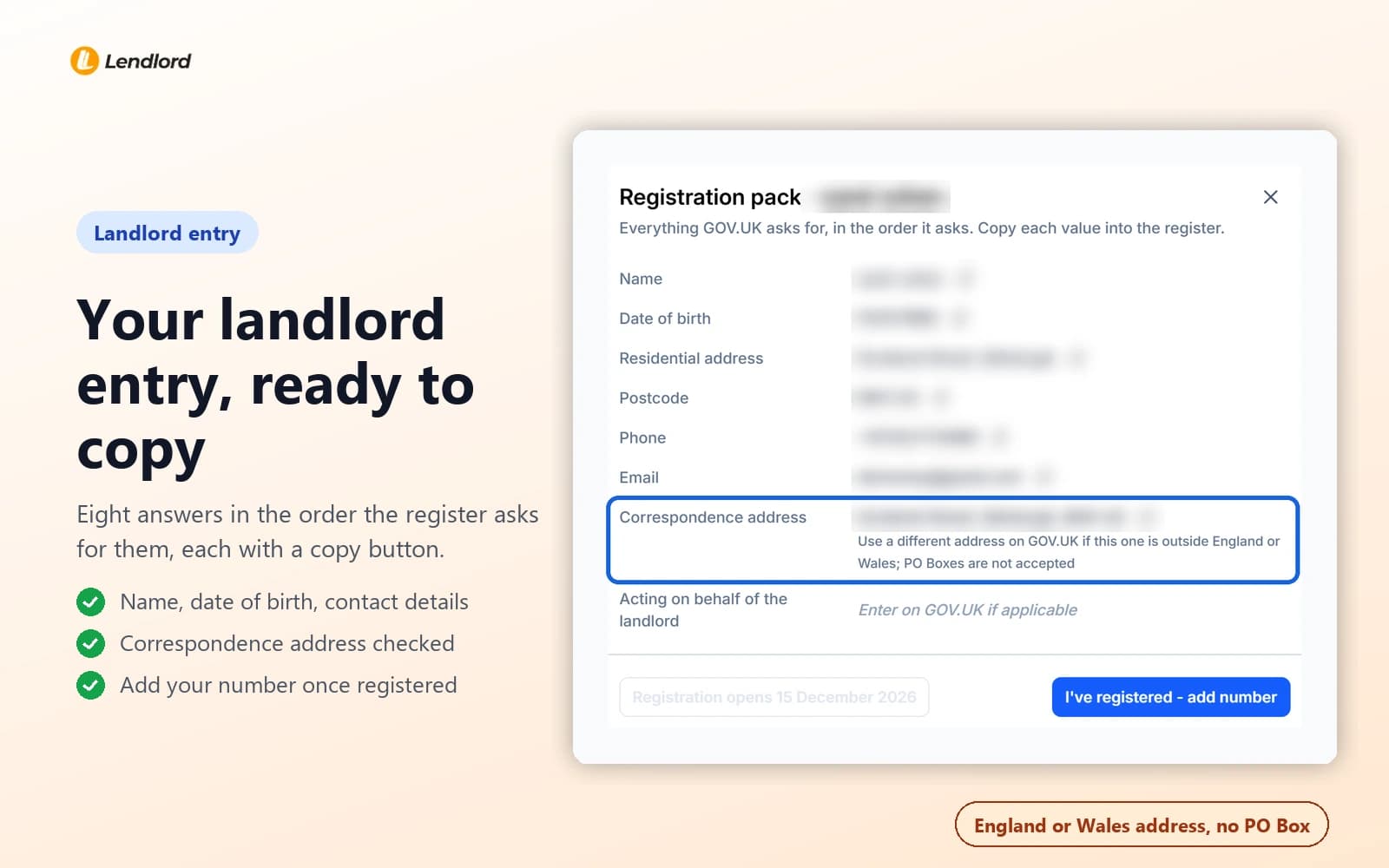
The Property Register card in the Compliance Hub holds your landlord answers ready to copy across when your window opens.
Open your registration packWatch the correspondence address. It must be an English or Welsh address, and a PO Box is not accepted. A landlord who lives abroad or in Scotland needs another address that meets the rule, such as a letting agent's office.
Step 2: property facts for each let
Part one describes the home itself. Most of it never changes, so it is the quickest part to collect. The one gap is the freeholder or managing agent contact for leasehold flats.
| GOV.UK asks for | Where to find it | Lendlord field |
|---|---|---|
| Address | Tenancy agreement or title register | Property record |
| Ownership type | Land Registry title: freehold or leasehold | Tenure Type |
| Dwelling type | Your own description of the home | Property Type |
| Bedrooms | Inventory or floor plan | Number of Bedrooms |
| Whether it is let now | Current tenancy agreement | Tenancy record |
| Freeholder, superior landlord or property manager contacts | Lease and agency contract | Not stored yet. Note them before you start |
Take a leasehold flat in a converted house. Tenure, type and bedrooms take a minute. The freeholder's contact details may sit in a lease you have not opened since you bought. Find them now, because the register asks for them before you can finish.
Step 3: tenancy and safety details
Part two can follow within 28 days of making the entry. For a home you intend to let, it is due within 28 days of the tenancy starting. Put the date in your diary on the day you make the entry.
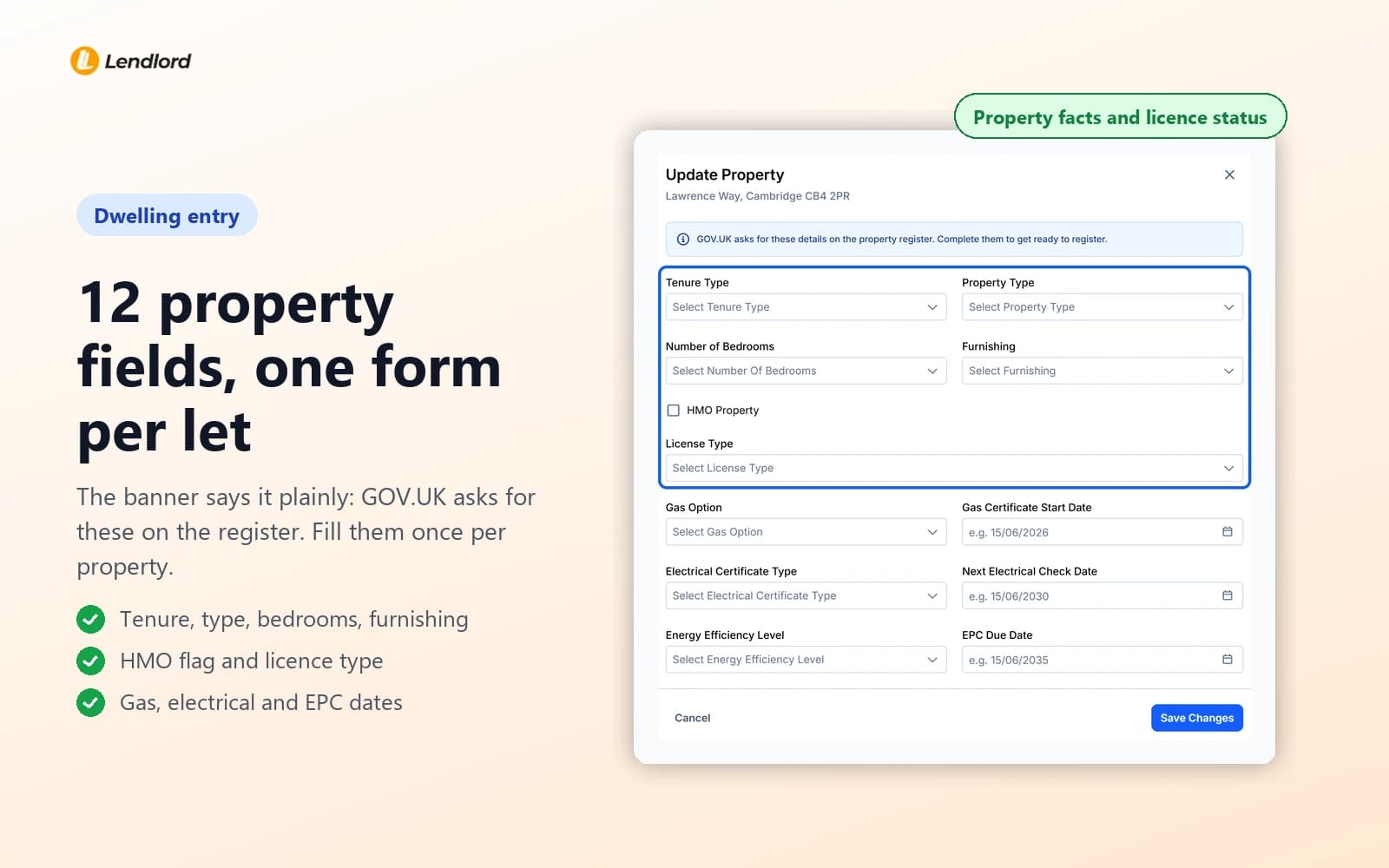
This is the part that stalls entries, because it needs certificate dates. An agent or property manager can supply it for you. Lendlord holds most of it on the Update Property form for each let.
| GOV.UK asks for | Where to find it | Lendlord field |
|---|---|---|
| Occupants and households | Tenancy agreement and your last visit | Named tenants on the tenancy record. Count other occupants yourself |
| HMO, additional or selective licence | Council licence letter | HMO Property and License Type |
| Gas safety record and its date | Gas Safe engineer's record | Gas Option and Gas Certificate Start Date |
| EICR or EIC and its expiry | Electrician's report | Electrical Certificate Type and Next Electrical Check Date |
| EPC details, and whether one had to be given | EPC register | Energy Efficiency Level and EPC Due Date |
| Energy efficiency exemption, if below standard | PRS Exemptions Register entry | Not stored yet. Keep the reference |
| Rent and how often it is paid | Tenancy agreement | Tenancy and payment schedule |
| Furnishing | Inventory | Furnishing |
Read the right-hand column as your to-do list. Two rows need paperwork Lendlord does not hold yet: superior landlord contacts and any energy exemption reference. Everything else is a dropdown or a date you can fill tonight.
Fix these before your window opens
The register asks for certificate dates, so a lapsed certificate shows on the entry itself. Clear these first:
- A gas safety record more than 12 months old.
- An EICR past its next check date.
- An EPC below E with no registered exemption.
- An HMO or selective licence still waiting on the council.
If a council visit is also due, the documents an HMO inspector asks to see overlap heavily with this list.
After you submit
- Pay £65 for each let. The operator sets the fee to cover its costs, so it can change.
- Store the registration number. In Lendlord, I've registered - add number saves it to the owner.
- Update the entry within 28 days of any change, such as a new tenant or a renewed certificate.
- Renew every 12 months. New lets join the renewal date of the entries you already have.
Later rules will put that number on every advert, so keep it where your team can find it. The Property Register tool page shows the full set of screens.
Fill the property fields once per let, and copy your landlord answers across when your region opens.
Start your register pack
Expert insight from Aviram Shahar, Co-Founder and CEO of Lendlord · PropTech entrepreneur · Last updated October 2026
Aviram's rule for portfolios: build the pack in property order, not certificate order. Finish one let completely, then move to the next. A half-filled pack across ten homes is harder to check than five finished ones.