Do Terraced Houses Out-Yield Semis? 25 of 27 Cities Say Yes
Published · Updated
5 min read
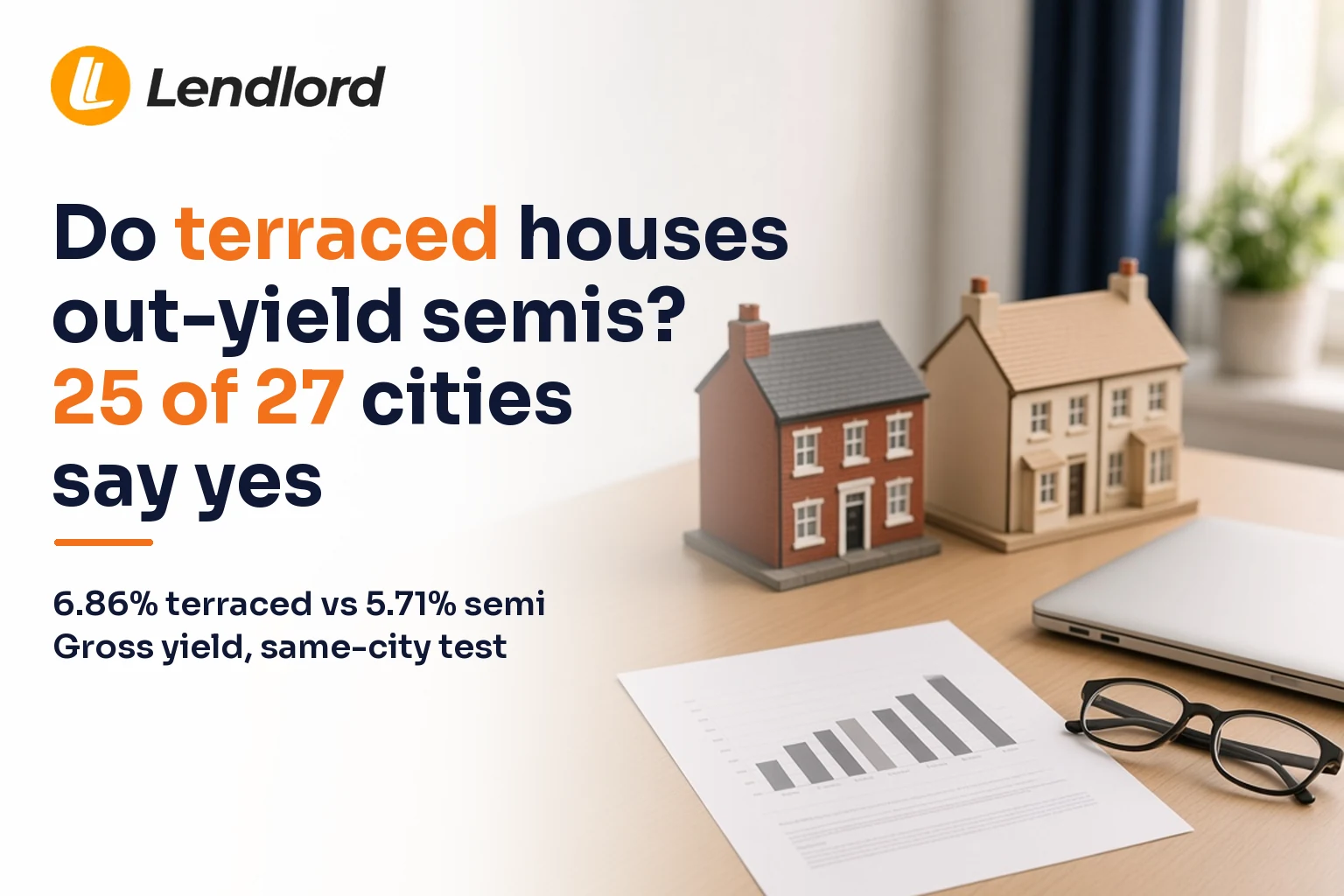
Do terraced houses out-yield semis?
On let homes on Lendlord, terraced houses show a median gross yield of 6.86%. Semi-detached houses show 5.71%. Gross yield is annual rent as a share of the property's recorded value, before any costs.
You may already let one to five properties and be choosing the next one. Median means the middle let home: half sit above it and half sit below.
A national figure mixes cheap and dear cities, so the fair pair is a terrace and a semi in one market. Inside the same city, terraced houses lead in 25 of 27 cities. The median city gap is 1.11 points, close to the national 1.15, and single cities run from -0.63 to 2.79.
Figures from let homes in Lendlord accounts approved for disclosure. Snapshot at 30 September 2026.
Gross yield by property type
The table ranks ten types by gross yield, highest first. Rent is the median monthly rent for let homes of that type.
| Property type | Median rent | Median gross yield | Let homes |
|---|---|---|---|
| Purpose-built flat | £928 | 7.32% | 360 |
| Terraced house | £895 | 6.86% | 4,237 |
| Apartment | £882 | 6.8% | 386 |
| Flat | £870 | 6.76% | 5,137 |
| Converted flat | £1,200 | 6.67% | 262 |
| End of terrace | £925 | 6.5% | 975 |
| Semi-detached house | £950 | 5.71% | 2,088 |
| Semi-detached bungalow | £925 | 5.29% | 97 |
| Detached house | £1,499 | 4.73% | 393 |
| Detached bungalow | £1,150 | 4.57% | 93 |
Source: let homes on Lendlord at 30 September 2026. The ten rows hold 14,028 of the 23,952 let homes in the snapshot. Property type is the label the landlord recorded.
Purpose-built flats lead this list, at 7.32%. Detached houses and detached bungalows sit at the bottom, at 4.73% and 4.57%. The median let semi collects £55 more a month than the median terrace (£950 against £895), on a lower gross yield. Apartment and Flat are separate labels landlords choose, so both stay in the table.
Your next purchase
Estimate the rent for that house
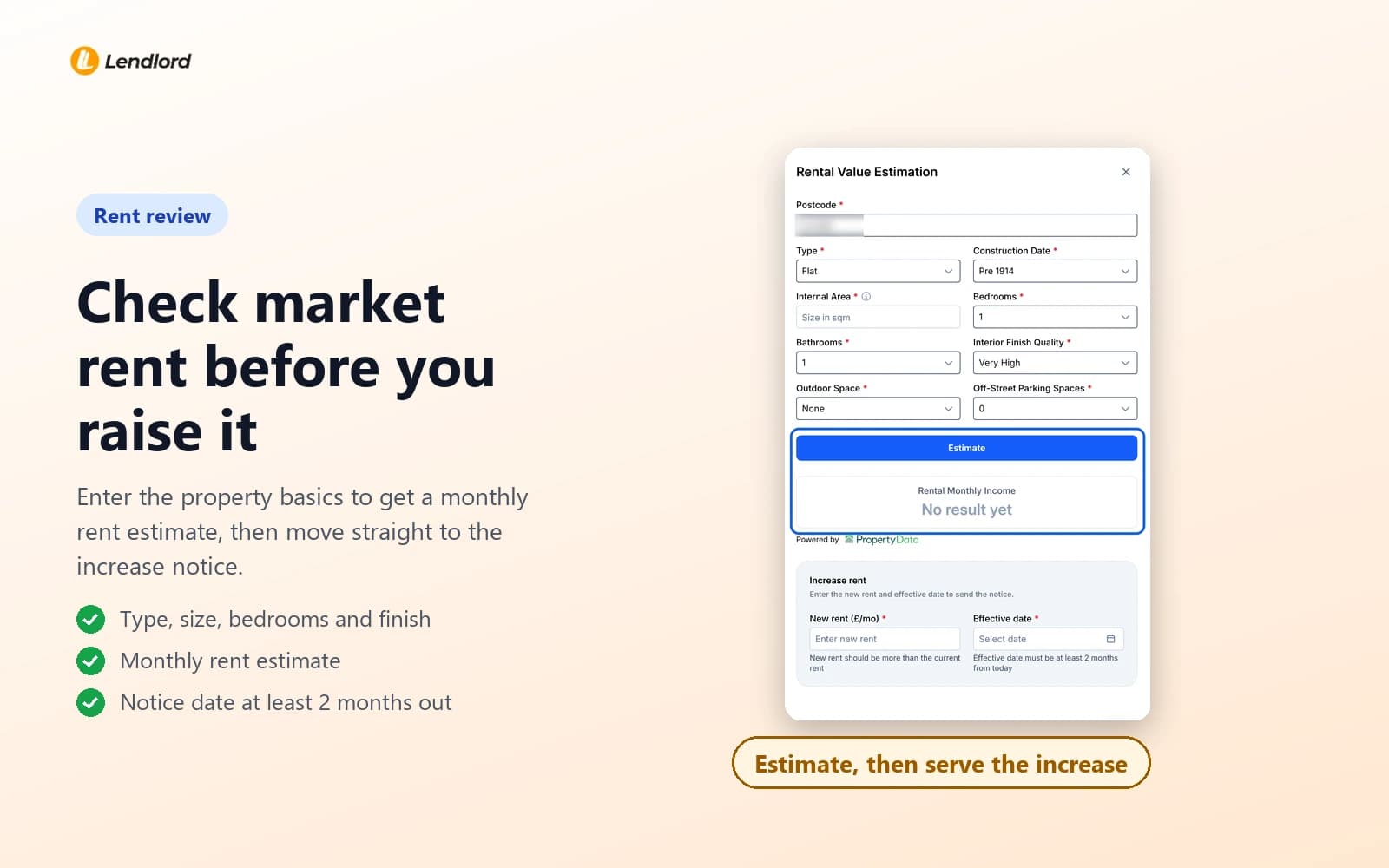
Enter the postcode, then pick terrace or semi as the type. Set the estimate against the row above.
Start an estimateSame city, same test
A national gap can hide a location effect, because the national 6.86% and 5.71% blend cheap markets with dearer ones. Hold the city still and compare the two types. That is the fairer test, and the terrace still leads.
The table lists all 27 cities, widest gap first. Across them the median gap is 1.11 points.
| City | Terraced | Semi | Gap (points) |
|---|---|---|---|
| Barnsley | 8.33% | 5.54% | 2.79 |
| Bradford | 7.81% | 5.19% | 2.62 |
| Hull | 8.43% | 5.86% | 2.57 |
| Doncaster | 8.75% | 6.6% | 2.15 |
| Stoke-on-Trent | 8.18% | 6.09% | 2.09 |
| Leicester | 6.47% | 4.65% | 1.82 |
| Liverpool | 8% | 6.35% | 1.65 |
| Middlesbrough | 8.73% | 7.2% | 1.53 |
| Thornaby | 8.37% | 6.89% | 1.48 |
| Peterborough | 7.5% | 6.07% | 1.43 |
| Darlington | 8.57% | 7.21% | 1.36 |
| Derby | 7.07% | 5.8% | 1.27 |
| Leeds | 7.11% | 5.94% | 1.17 |
| Manchester | 6.64% | 5.53% | 1.11 |
| Stockton-on-Tees | 9% | 7.91% | 1.09 |
| Blackpool | 7.88% | 6.83% | 1.05 |
| Luton | 6% | 5.08% | 0.92 |
| Sheffield | 6.72% | 5.98% | 0.74 |
| Sunderland | 7.8% | 7.15% | 0.65 |
| London | 5.25% | 4.63% | 0.62 |
| Newcastle upon Tyne | 6.79% | 6.29% | 0.5 |
| Coventry | 5.51% | 5.24% | 0.27 |
| Chatham | 5.6% | 5.35% | 0.25 |
| Nottingham | 6.71% | 6.58% | 0.13 |
| Birmingham | 5.86% | 5.74% | 0.12 |
| Swindon | 6.2% | 6.44% | -0.24 |
| Bristol | 6.17% | 6.8% | -0.63 |
Source: 27 cities with at least 10 let homes of each type, 30 September 2026. Gap is the terraced gross yield minus the semi, in points. Hull semis, Thornaby terraces, Newcastle upon Tyne semis and Swindon semis each rest on 10 let homes. Same city, different streets.
Barnsley is the wide end, at 2.79 points. Bristol's gap is -0.63 points and Swindon's is -0.24 points, so semis lead there. Judge the house, not the label.
Why landlords buy up north for yield
What the headline yield hides
These figures are gross. They leave out voids, running costs and the mortgage. Read the gap between gross and net before you treat 6.86% as money you keep.
Some terraced houses are let by the room, and that can lift the rent. The snapshot does not split HMOs by type. See what letting by the room adds.
End of terrace sits between terraced houses and semis, at 6.5% on 975 let homes. Use that row when the house is an end, not the terraced house row.
The semi's extra rent is the trade. On these medians, the semi trades some gross yield for more rent each month. On a single let, that rent is what a lender tests. On a room let, the terrace can look stronger than the same house let whole. Write both rents down first, then see which house still works once the costs come off.
Three checks before you offer
Tick the list against the house you would buy.
Tick each line before you trust the asking gross yield.
- Compare the asking gross yield with the same type in the same city. If your city is in the table, use that row, not the national 6.86%.
- Turn the gross yield into rent and costs for this house. Model the deal, then work out the yield for your own area.
- Test the rent this house would really get, not the median £950 for a semi or £895 for a terrace. Then check the rent clears the lender's stress test.
If interest cover fails, speak to a broker before you offer. If the rent is only a listing line, get a written rent valuation from a local letting agent. Tax on the rent is for an accountant.
These are let homes in Lendlord accounts approved for disclosure, with rent above zero at 30 September 2026. Gross yield is annual rent over the recorded value. Property type is what the landlord recorded. Let homes with no property type recorded sit in no row.
Types with fewer let homes than the smallest row, and non-residential types, are left out. A city pair needs at least 10 let homes of each type. This describes let homes on Lendlord, not the UK market. It is a pattern across houses, not proof that the type sets the yield.
Save the terrace and the semi
Run both types for the same city and keep the one that still works.
Save an analysis
Expert insight from Aviram Shahar, Co-Founder and CEO of Lendlord · PropTech entrepreneur and property investor · Last updated November 2026
Model the deal twice. Once on the terraced house, once on the semi. Keep the house that still works when you use the same-city row, not the national headline.
Official data sources
- HM Land Registry: UK House Price Index
- ONS: Price Index of Private Rents
- GOV.UK: English Housing Survey
They publish the official house price, private rent and housing stock figures. The medians above are Lendlord's own.