Your Agent Supplied the Tenancy Agreement, but Who Checked It?
Published
4 min read
The agreement arrives from your agent, already filled in. Tenant name, rent, start date, and several pages of legal wording you did not write.
You are allowed to interrogate that wording before you sign it. Ask who drafted it, when it was last checked against current law, and which clauses were added for your property. A good agent answers all three without going to look.
Most landlords never ask. In Lendlord's September 2026 tenancy agreement survey, 45.3% took their agreement from a letting or managing agent, and 90.6% had no solicitor review it. The survey breakdown carries the rest of the numbers.
The five questions worth asking
Send them in one email. Written answers matter more than a phone call, because writing is what you fall back on if a clause is ever tested.
Timing helps but is not decisive. Asking before a new letting is routine. Asking about an agreement already running is still worth doing, because that wording governs the rest of the tenancy either way.
- Who drafted this wording, and when was it last reviewed against current legislation?
- Is it written for a periodic tenancy, or is it an older fixed-term agreement with the dates changed?
- Which clauses are your standard set, and which were added for this property?
- When the law changes mid-tenancy, who updates the wording and tells me?
- If a clause is challenged, does your firm stand behind it?
If the reply is vague
An agreement you can read before it goes out
Lendlord's generator produces a periodic agreement you can customise clause by clause. It is free, and a solicitor drafted the base wording.
Build your own agreementWhat a good answer sounds like
You are listening for specifics. A confident agent names the firm, the review date, and the clauses they added. A vague reply is not proof of a problem, but it tells you nobody has looked recently.
| What you asked | Thin answer | Answer worth having |
|---|---|---|
| Who drafted it, and when was it last reviewed? | It is our standard agreement. | A named firm or in-house legal team, and a review date you can check. |
| Is it written for a periodic tenancy? | It covers everything. | Drafted for a periodic tenancy, not a fixed-term document with the dates edited. |
| Which clauses were added for my property? | Nothing unusual. | A short list of the added clauses and the reason each one is there. |
Question two catches the most common issue right now. Plenty of agreements in circulation are fixed-term documents with the term deleted, which leaves clauses that assume an end date the tenancy no longer has.
Question five is the one agents pause on, and the pause tells you something. Few firms will indemnify a landlord against a clause failing. A straight answer either way is what you need, because it shows where the risk actually sits.
The agreement is yours, not your agent's
Your agent supplies the document. You are the contracting party. If a clause turns out to be unenforceable, it is your tenancy that carries the consequence, not their template library.
This is not an argument for distrusting your agent. Good agents keep their wording current and will say so in a sentence. It is an argument for knowing what you signed, and for keeping a copy you can open without asking anyone.
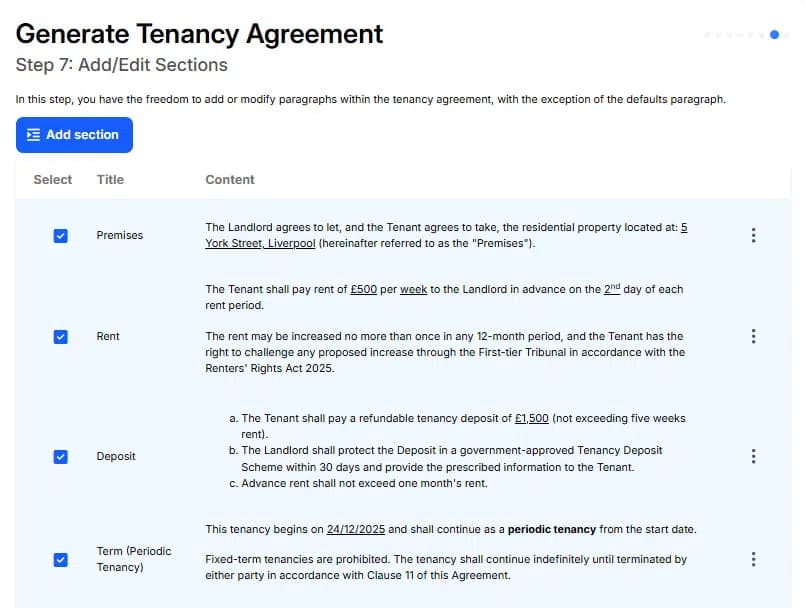
Mid-tenancy the rules tighten further. Some terms can be varied by agreement and others cannot, which the guide to what you can change mid-tenancy sets out clause by clause.
If the answers do not add up
Two routes are open, and neither requires falling out with your agent.
Ask in writing for confirmation of who reviewed the wording and when. Most agents can produce that in a line. If it does not arrive, use an agreement you control instead: our free tenancy agreement template is one option, and there are others.
A flat refusal is different from a slow reply. Letting agents must belong to an approved redress scheme, and that scheme exists for complaints of exactly this kind. Find out which one your agent is registered with before you need it.
Why we built an agreement you can read clause by clause
Whichever route you take, file the answers with the agreement. A year from now you will not remember which version the tenant signed, and the reply you were sent is the fastest way back to it.
Survey note: Lendlord ran the tenancy agreement survey inside the web app between 8 to 14 September 2026. 53 landlords answered the question on where their agreement came from. Percentages are of respondents, not of all UK landlords.
Rather not chase the answer?
Build a periodic agreement from solicitor-drafted wording. Edit the clauses that need changing, then download it.
Create a tenancy agreement free
Expert insight from Aviram Shahar, Co-Founder and CEO of Lendlord · PropTech entrepreneur · Last updated September 2026
Aviram treats this as a records question before a legal one. Landlords who can produce the signed agreement and the reply that explains its wording settle disputes quickly. The ones who cannot spend a week reconstructing what they agreed to.