Rate-Rise Bets Are Back. 1 in 5 Landlord Mortgages Still Sit Under 3%
Published
5 min read
Of 15,130 live mortgages from Lendlord accounts approved for disclosure, 20.2% still had a recorded rate under 3% on 30 September 2026. Your fixed rate ends in the next year, and the jobs figures published on 20 October have markets talking about a November Bank Rate decision. You already know the rate on your own loan. What you cannot see is where other recorded mortgages sit while you decide whether to switch early.
The median recorded rate is 4.46%. A recorded rate is the rate saved on the mortgage. An end date is the date saved as the end of the current product. A rate band is the group that recorded rate falls into.
This page does not guess the Bank of England vote. It shows the cheap band, the end dates, and one interest-only example.
Figures last checked on 30 September 2026. Snapshot taken that day.
How many landlord mortgages renew soon
Expiry shares below are counted only among mortgages that have an end date. They are not shares of all 15,130.
| Timing | Share |
|---|---|
| Within 6 months | 10.2% |
| Within 12 months | 24.3% |
| Within 24 months | 42.5% |
| Past the recorded end date | 27.6% |
Source: the 15,130 mortgages in this set, snapshot 30 September 2026. The four rows are shares of mortgages with an end date, not of every mortgage.
Past the recorded end date means the saved date has already passed. The loan may have moved to a variable rate, or the date was never updated. It is not proof of a reversion rate.
Separately, 34.0% of the 15,130 have no end date recorded at all. If yours is blank, the 6-month row cannot include you. The wider 12-month view is in the 12-month renewal picture.
The rate bands landlords hold today
Place your own rate in this table. The largest band is 4% to under 5%, at 26.2%. The cheap band, under 3%, is still 20.2%.
| Recorded rate | Share |
|---|---|
| Under 3% | 20.2% |
| 3% to under 4% | 19.9% |
| 4% to under 5% | 26.2% |
| 5% to under 6% | 22.7% |
| 6% or above | 10.9% |
Source: the same 15,130 mortgages, snapshot 30 September 2026. Shares of the full set.
If your recorded rate is under 3% and the end date is inside 12 months, a renewal now is most likely to move you to a higher rate. If you are already at 6% or above, a new fix is a comparison, not an automatic saving.
Today's products
See what your LTV can get now
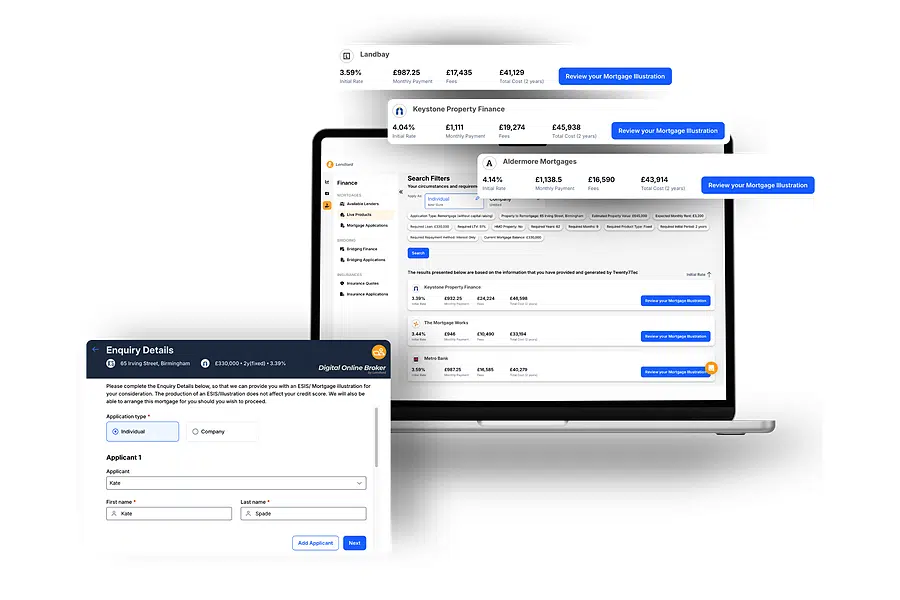
Live products list the rates for your loan size and loan to value.
Open live mortgage productsBigger portfolios, different exposure
Smaller portfolios still hold more of the under-3% band. Larger ones sit on a higher median recorded rate, and more of them are already at 6% or above.
| Homes owned | Mortgages | Median recorded rate | Under 3% |
|---|---|---|---|
| 1 to 3 | 2,459 | 4.3% | 25.1% |
| 4 to 10 | 5,682 | 4.35% | 23.4% |
| 11 to 20 | 3,386 | 4.51% | 19.3% |
| 21 or more | 3,603 | 4.73% | 12.7% |
Source: mortgages in this set, snapshot 30 September 2026. Portfolio size is homes owned.
At 6% or above, the share is 7.3% for 1 to 3 homes and 15.8% for 21 or more. Among mortgages with an end date, 24.4% in the smaller group expire within 12 months, against 18.1% for 21 or more.
What a jump from 3% to 6% costs
Interest-only example, not a median loan
Take an interest-only loan of £140,000. Interest-only means you pay the interest each month and the balance stays put. Monthly interest is the balance times the rate, divided by 12.
At 3% that is £350 a month. At 6% it is £700 a month. The gap is £350 a month, before any fee and before the lender's stress test. Swap in your own balance. The rate change is the part this example can show.
For a full five-year comparison at a held Bank Rate, use five-year fix maths. Do not read that page as a forecast. This one is not a forecast either.
A product decision, not a prediction
What to check this month
Five checks before you wait
Do them in this order. The headline does not replace any of them.
- Read the recorded end date. If it is blank, fill it in before you judge the 6-month row.
- Write down your rate band from the table: under 3%, 3% to 4%, 4% to 5%, 5% to 6%, or 6% and above.
- Ask the lender whether an early product switch is open, and what the exit fee is.
- Check rent cover at the stress rate with the rent cover at the stress rate guide.
- If the end date is inside 6 months, book a broker. Waiting for the November decision is not a plan.
To put your own balance through the same monthly sum, run your own figures. Talk to a broker before you pay an exit fee. This page cannot tell you the product you will be offered.
Questions on the renewal
How many of these mortgages renew within a year?
Among mortgages with an end date, 10.2% end within 6 months, 24.3% within 12 months and 42.5% within 24 months. A further 27.6% are already past the recorded end date. That can be a variable rate, or a date nobody updated. It is not proof of a reversion rate.
What share of landlord mortgages still sit under 3%?
20.2% of the 15,130 have a recorded rate under 3%. The median recorded rate is 4.46%. The largest band is 4% to under 5%, at 26.2%.
Does a larger portfolio change the picture?
Portfolios of 1 to 3 homes have a median recorded rate of 4.3%, and 25.1% are under 3%. Portfolios of 21 or more have a median of 4.73%, and 12.7% are under 3%.
What should I check before I wait?
The end date, your rate band, whether an early switch is open, and rent cover at the stress rate. If the end date is inside 6 months, speak to a broker this month.
These figures describe mortgages that landlords record on homes they own in Lendlord, not every UK buy-to-let mortgage. The snapshot is 30 September 2026 and the count is 15,130 live mortgages from Lendlord accounts approved for disclosure. A recorded rate is whatever was saved, and it can be out of date.
Expiry shares use only mortgages with an end date. A passed date is not proof of a follow-on rate. The £140,000 sum is an example, not a median loan.
Book the product conversation if the end date is inside 6 months. A landlord who waits for a calmer headline often meets the lender with weeks left, when the case has to be underwritten rather than priced.
Put the end date next to a live rate
If the end date is inside 6 months, compare a product now. The November headline will not fill the date in for you.
Check a product switch
Expert insight from Simmy Kaur, Director of Buy to Let Mortgages · Financial Reporter's 30 Under 30 2025 · Last updated October 2026
Official data sources
- Bank of England: Bank Rate. Linked because the headlines refer to it. No Bank Rate figure is quoted here.
- ONS labour market overview. Linked as the jobs release published on 20 October. No ONS figure is quoted here.