How Long Does a Bridging Loan Take? 218 Timed Deals Say
Published
5 min read
In Lendlord's latest bridging deals, of which 272 are approved for disclosure, the median time to funds was 57 days across 218 timed deals, checked on 30 September 2026. Applications in 2026 sit at a median of 34 days, and 26% of timed auction files released funds within 28 days of the application.
Days to funds is the count from the application date to the day the lender releases the money. Timed deals are the 218 files with a usable timeline inside the 272 disclosed deals. The auction completion window is usually 28 days from the hammer.
Advertised speeds are the fast end of this book, not the middle. You will see the move since 2023, which strategies run long, and the steps that shorten a file.
Figures last checked on 30 September 2026, for applications from June 2021 to July 2026.
Days to funds, year by year
The median has fallen in every year of this cut. Treat the 2026 figure as a recent pace, not a promise for the next case.
| Application year | Median days | Timed deals |
|---|---|---|
| 2023 | 104 | 45 |
| 2024 | 65 | 64 |
| 2025 | 52 | 60 |
| 2026 | 34 | 37 |
Source: the 272 disclosed Lendlord bridging deals, 218 timed deals. Checked 30 September 2026. The 2026 row runs to July.
A 2023 file at 104 days and a 2026 file at 34 days are 70 days apart. If your solicitor still works to the older pace, the recent median will not rescue a tight completion. Once the money is out, see how long bridges stay open once funded.
Auction lots and the 28-day window
26 of 99 timed auction files released funds within 28 days of the application. That share is 26%. The auction median is 43 days, so a typical file misses a 28-day completion if the application starts on the day of the hammer.
The count runs from application to funds, and the application can start before the auction. That is the part you can still move.
A 28-day auction completion
Take an auction that completes 28 days after the hammer. The auction median here is 43 days from application to funds, which is 15 days longer than that window. Put the application in at least 15 days before you bid, so a median file can still meet the date.
The mix of those auction files is in what the auction files looked like. Get indicative terms while the lot is still on the catalogue. The completion clock starts when you win.
Before the hammer
Name the exit before the valuation
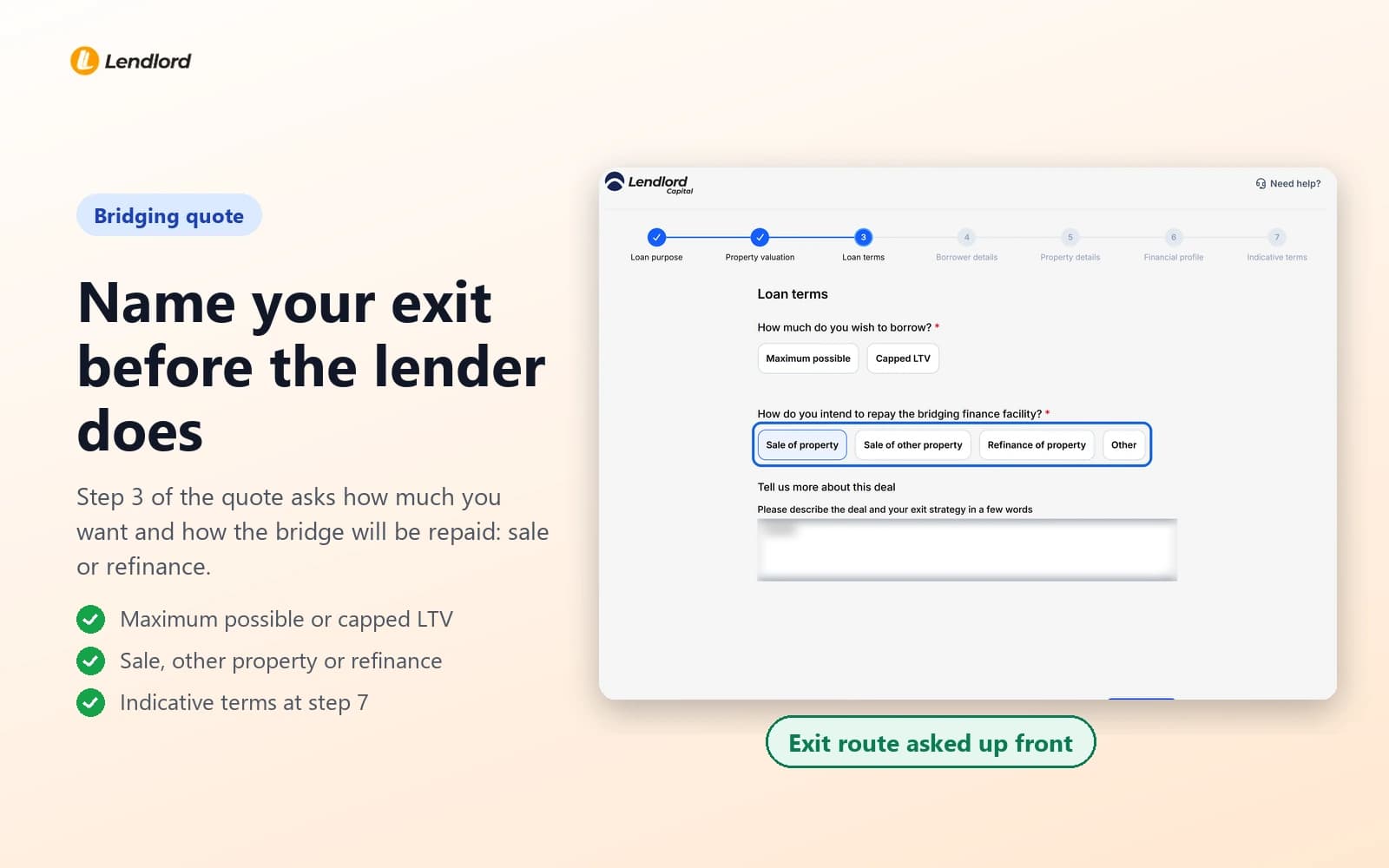
Valuers and lenders look at how you will repay. Put the exit on the file before you ask for terms.
Start a bridging enquiryWhy buy-to-let and refurbishment files take longer
A buy-to-let file often waits on a tenancy and an exit into a mortgage. A refurbishment file waits on the works and a fresh valuation. An auction file is a purchase with a fixed date, so match the median to the strategy.
| Strategy | Median days | Timed deals |
|---|---|---|
| Auction | 43 | 99 |
| Refurbishment | 77 | 49 |
| Buy-to-let | 86 | 48 |
Source: the 272 disclosed Lendlord bridging deals, timed deals. Checked 30 September 2026.
If the exit is a refinance after works, plan closer to the buy-to-let median of 86 days, or the refurbishment median of 77 days, than to the auction row.
Personal or company borrower
A company purchase adds company documents, director ID and sometimes a charge at Companies House. Speak to a broker before you exchange if the borrower is a company and the completion date is already tight. The book does not measure those steps as the cause of the gap.
| Borrower | Median days | Timed deals |
|---|---|---|
| Personal | 40 | 44 |
| Company | 60 | 173 |
Source: the 272 disclosed Lendlord bridging deals, 44 personal and 173 company timed deals. Checked 30 September 2026.
Personal borrowers show a median of 40 days. Company borrowers show 60 days, which is 20 days more. Start earlier on a company file. Do not treat the gap as a rule for every case.
How to be at the fast end
Only 2 timed deals released funds within 7 days, and 12 within 14 days, out of 218. The steps below are what you can move.
Steps that shorten the timeline
Do these in order. Each one removes a wait after the application is in.
- Send the application ahead of the auction. On an auction file, start at least 15 days beforehand.
- Arrange valuer access before the application goes in.
- Instruct the solicitor and order searches the same day.
- Evidence the exit with the application: refinance, sale, or the works plan.
- Have ID and proof of deposit ready for every person on the file.
See auction bridging terms. Ask whether one firm can act for you and the lender (dual representation), which can save days, when the completion window is 28 days.
Where the days actually go
Check your own timeline
Before you exchange
If a line is still open, plan with the median, not the fastest file.
- The application is already in, or you have a clear reason it is not.
- The valuer can get into the property on the date the lender asks.
- A solicitor is instructed and searches are ordered.
- The exit route is written down, with the evidence the lender will ask to see.
- ID and proof of deposit are ready for everyone named on the loan.
First, cost the bridge for your term. Then ask a broker if that date is realistic for your strategy.
Questions on the timeline
How long does a bridging loan take?
The median here is 57 days from application to funds, across 218 timed deals. Applications in 2026 have a median of 34 days. That is the middle of funded files, not a time a lender has agreed to hit.
Can an auction purchase complete inside 28 days?
26 of 99 timed auction files released funds within 28 days of the application. The auction median is 43 days, so start the application before the hammer if the completion window is 28 days.
Does borrowing through a company change the timeline?
Company files show a median of 60 days, against 40 days for personal borrowers. Allow time for company papers. The figures do not prove the company structure caused the extra days.
What can I do to be at the fast end?
Apply early, book valuer access, instruct a solicitor, evidence the exit, and have ID and deposit proof ready. Only 12 of 218 timed deals funded within 14 days, so treat that pace as rare.
These figures describe bridging loans arranged through Lendlord, not the whole UK market. The set is the 272 disclosed deals. Days to funds uses 218 timed deals, with outliers and same-day records left out. The window is applications from June 2021 to July 2026, funded through August 2026.
The book cannot show declined applications, or why one file ran long. A median is the middle value, so half the timed deals took longer.
Put the completion date on a real file
Get indicative terms while the lot is on the catalogue. A 43-day auction median does not fit a 28-day completion unless the application is already moving.
Check a completion date
Expert insight from Clare Harris, Bridging Loan Specialist · Director of Growth, 12+ years in loans and lending · Last updated October 2026
Official data sources
- RICS Red Book valuation standards, linked because a bridging valuation follows them. No figure on this page is taken from RICS.
- Registering land or property with HM Land Registry, linked because the purchase has to be registered. No figure on this page is taken from that guidance.