10 Auction Finance Case Studies - Analysed: How UK Investors Win the 28-Day Race
Published · Updated · 28 min read

In 2025 the UK property auction market broke every record on the books: 28,975 lots sold and almost £5.9 billion raised. Behind that headline sits a quieter story - the rise of auction bridging loan products as the engine of the auction room. This long-read pulls apart ten illustrative finance for auction property case studies, showing how investors structure deals, what lenders actually look at, and where most auction purchases either succeed or quietly fall apart.
On this page
The UK auction market in 2025-26: a snapshot
Auction rooms used to be the preserve of cash-rich trade buyers chasing distressed lots. That world is long gone. In 2025 around 28,975 lots sold across the UK, with residential auctions alone generating roughly £4.79 billion from 25,682 lots. The broader market raised £5.9 billion, up about 7.1% year on year, with the volume of lots offered climbing past 41,000. Average residential prices rose around 4.2% to about £177,471.
Growth was not evenly distributed. The North East and London each posted sales volume increases of roughly 14.8% and 14.7% respectively, followed by the East Midlands at 12.6% and the South West at 10.6%. Investors are following the yield map: stronger gross yields in the regions, longer-term capital growth in London. A side-effect is that auction property finance deal flow has shifted with the geography, and specialist lenders have tooled up for instructions outside the M25.
The most underappreciated number is on the lender side. By Q3 2025, the UK bridging loan book reached about £13.7 billion, and auction purchases now account for roughly 13% of bridging activity. In plain English: more than one in eight bridging pounds is now going into an auction completion. That is what makes auction finance worth analysing as a category, not just as a footnote inside a broader bridging market.
How auction finance actually works
The mechanics of the auction room are simple and unforgiving. When the hammer falls you have exchanged contracts. You pay a 10% deposit on the spot, and you typically have 28 days from the fall of the hammer to complete. Miss that deadline on a traditional unconditional auction and the seller can rescind, keep your deposit and pursue you for the difference if the lot is resold for less. The 28-day clock is the single most important fact in auction property finance.
That timeline is also why high-street mortgage lenders are effectively absent from the auction room. A standard residential or buy-to-let mortgage typically takes 6 to 12 weeks to underwrite, value and complete. The numbers do not work. 28 day completion finance is the product designed to fit between the auctioneer's gavel and a long-term mortgage that comes later.
Traditional auction versus Modern Method of Auction
Two formats dominate. Traditional (unconditional) auctions - the Allsop, Auction House, SDL and Savills format - require the 10% deposit and full exchange on the fall of the hammer, with completion at 28 days. Modern Method of Auction (MMoA), also called conditional auction, gives the winning bidder a 56-day window: 28 days to exchange and a further 28 days to complete, in return for a non-refundable reservation fee. MMoA is intentionally mortgage-friendly, but as Case Study 5 shows, a down-valuation can still implode the timeline.
Why a short term bridging loan is the right tool
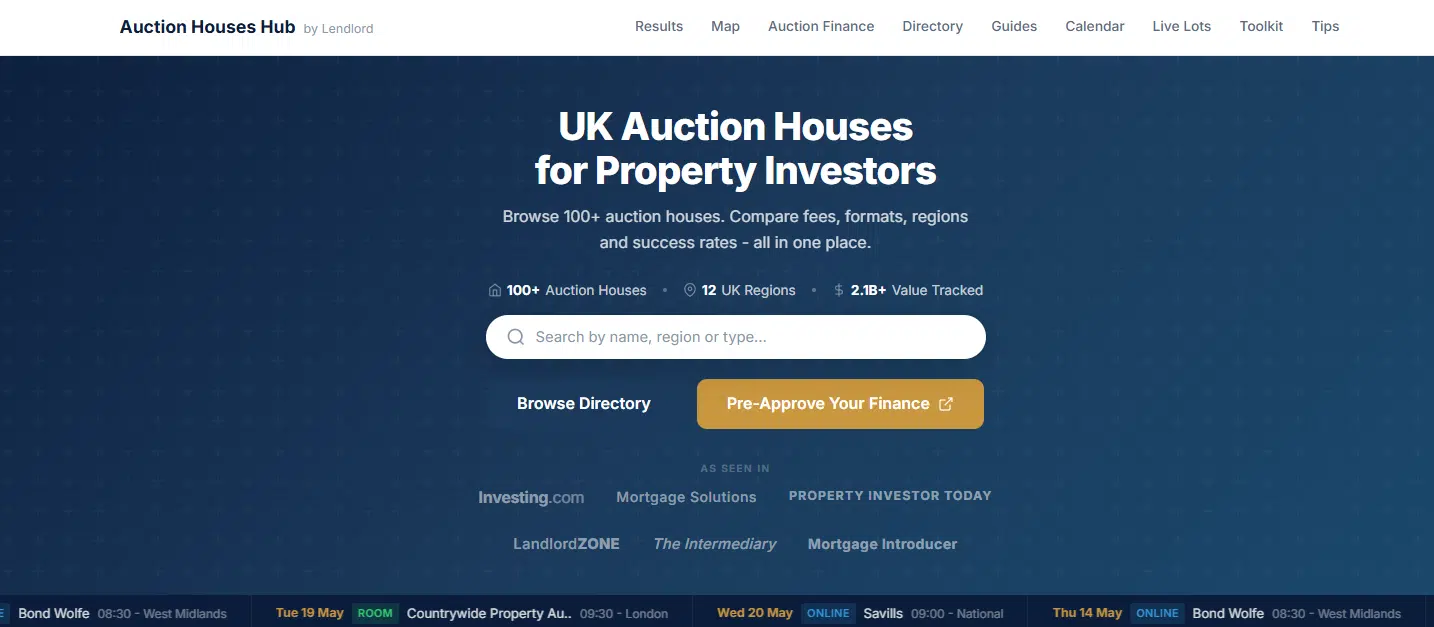
An auction-day buyer typically needs a short term bridging loan with two qualities: it can be underwritten in days rather than weeks, and it can be priced on an asset that a mortgage lender would refuse - missing kitchens, short leases, defective title, non-standard construction or a development angle.
The numbers behind a typical auction bridge in 2026
Pricing today clusters in fairly tight bands. A clean residential lot with a clear exit will usually price as follows:
- Up to 50% LTV: 0.7% to 0.95% per month
- 50% to 65% LTV: 0.75% to 1.05% per month
- 65% to 75% LTV: 0.8% to 1.10% per month
- Arrangement fee: typically 1.5% to 2% of the gross loan
- Exit fee: 0% to 1.5% (many specialist lenders are now zero)
- All-in set-up costs: roughly 2% to 4% of the loan (valuation, legals, admin, lender legals)
- Time to funds: 7 to 14 working days is realistic; 5 days is possible on simple cases with paperwork ready
Interest is usually retained (deducted upfront from the gross loan) or rolled up (added to the balance and repaid on redemption). Serviced interest - paid monthly - is available but unusual on short auction bridges because the buyer is usually re-leveraging the asset, not extracting income. If you want to see how the numbers behave on different loan sizes and terms, the Lendlord dynamic bridging loan calculator models exactly this trade-off and slides between 3, 6, 9 and 12-month terms.
Other situations a bridging loan is built for
While this article focuses on finance for auction property, the same product range also covers other time-sensitive scenarios that often run alongside auction activity: a bridging loan for chain break when a buyer in a portfolio sale withdraws, a development exit re-bridge when the original facility is expiring, or capital-raising against an unencumbered investment unit to fund an auction deposit. Chain break bridging in particular is worth understanding even if your main interest is auctions - many portfolio landlords use a chain break bridging loan on one property to free up cash for a different auction lot the following month.
The auction calendar matters more than you think
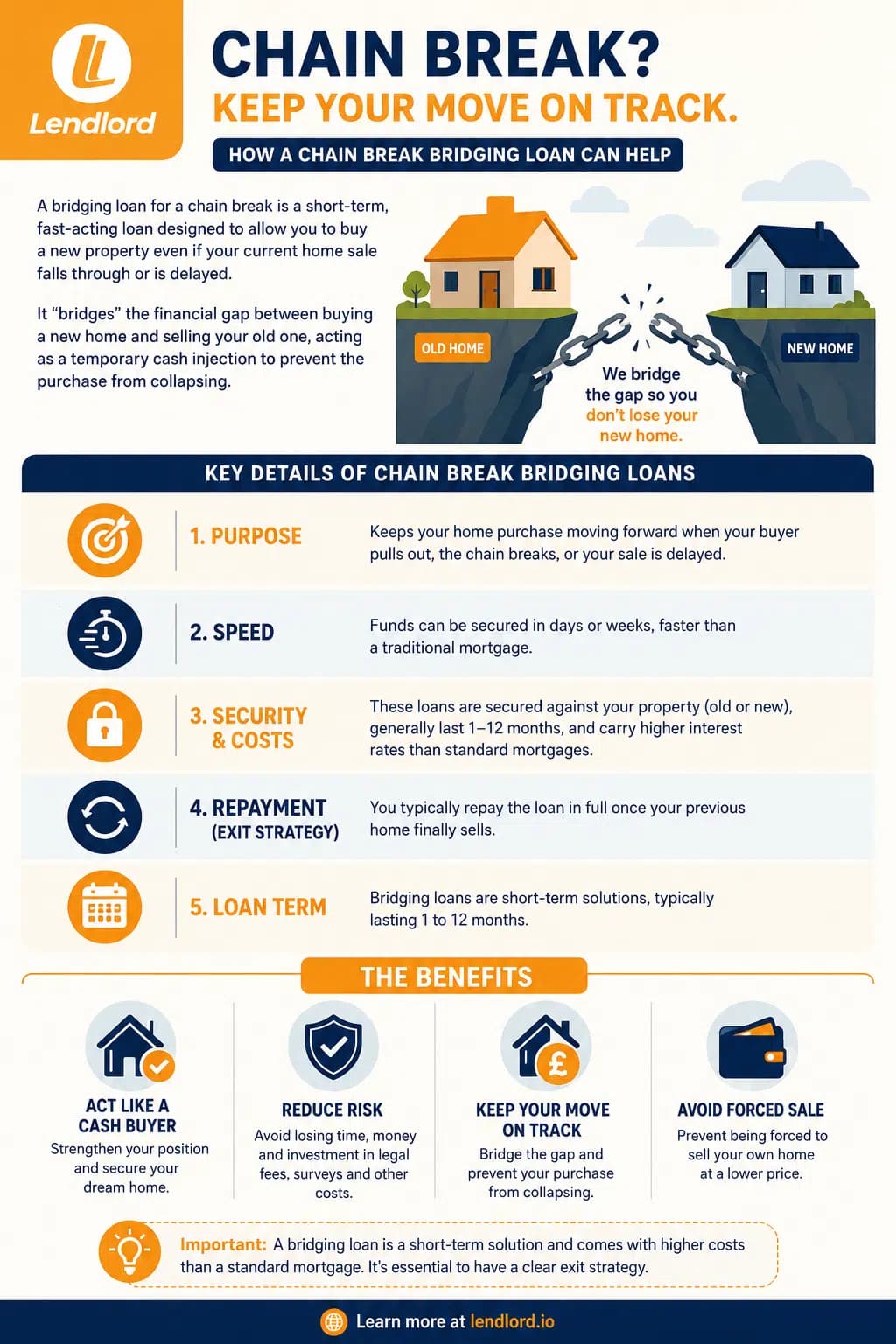
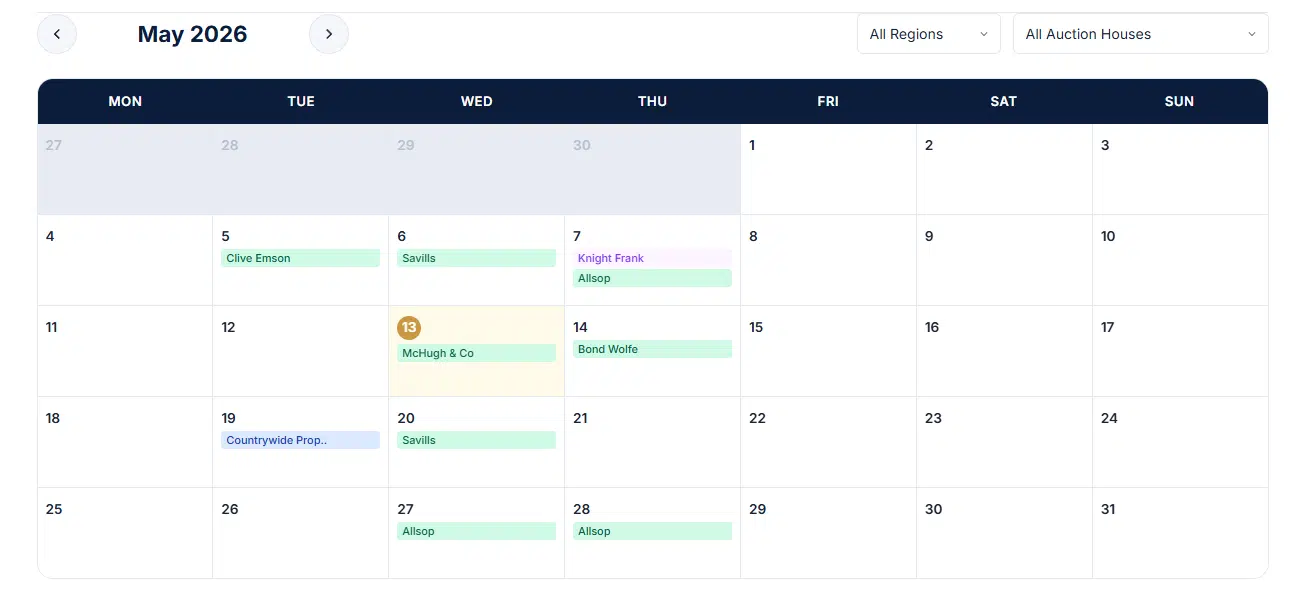
One of the most overlooked variables in auction strategy is timing. Lot supply is heavily clustered around the major auctioneers' published catalogues, and your urgent auction finance sourcing window starts the moment the catalogue drops - typically four to six weeks before the sale. A buyer who only starts thinking about lender selection after the catalogue is live is already on the back foot. Investors who plan around the UK auction calendar tend to win cleaner deals at better prices.
Scope note for this article. Every case below is an investor, landlord or developer transaction on investment property - buy-to-let acquisitions, refurbishment trades, HMO and PD conversions, commercial-to-residential schemes and similar. Owner-occupier purchases (buying a home to live in) sit under a different lending regime and are not covered here.
The 10 auction finance case studies
The case studies that follow are illustrative composites - drawn from the patterns we see repeatedly in published lender case files and broker submissions, with figures rounded for clarity. They are not commitments and not specific borrowers. Each follows the same five-part structure: Profile, Challenge, Finance Structure, Exit and Analysis.
Case Study 1 - The classic 28-day race: uninhabitable Victorian terrace, North West
Profile
A part-time landlord with three existing buy-to-let properties spots a probate lot in a regional auction catalogue: a two-bedroom Victorian terrace in a commuter town outside Manchester, guide £75,000. The property has been empty for 18 months, has no working kitchen or bathroom, and a clearly leaking roof. Comparable refurbished stock in the road trades around £155,000.
The Challenge
This is a textbook bridging loan for uninhabitable property at auction situation. No mainstream BTL lender will fund it: the property does not have a functional kitchen or bathroom, so it fails the basic "habitable" test. The borrower has the 10% deposit on the day but cannot raise £80,000+ from his own resources in 28 days. He needs auction finance in 7 days from offer to funds release to leave margin for the legal process.
Hammer price£92,000Gross bridge£64,400LTV70%Term9 monthsRate0.89% pcmTime to funds12 working days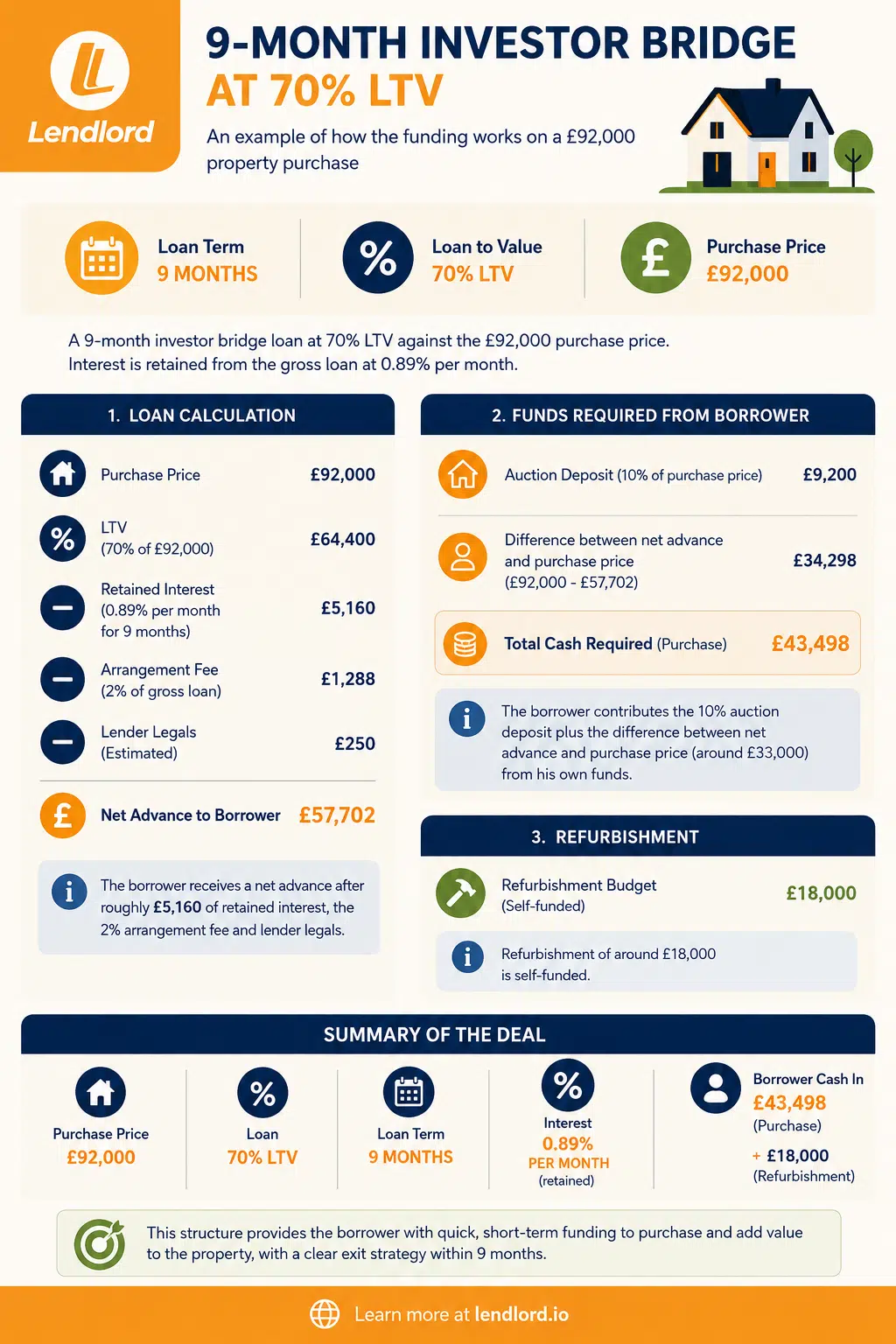
The Finance Structure
A 9-month investor bridge at 70% LTV against the £92,000 purchase price. Interest is retained from the gross loan at 0.89% per month, so the borrower receives a net advance after roughly £5,160 of retained interest, the 2% arrangement fee and lender legals. The borrower contributes the 10% auction deposit plus the difference between net advance and purchase price (around £33,000) from his own funds. Refurbishment of around £18,000 is self-funded.
The Exit
Five months in, with a new kitchen, bathroom, re-felted roof and rewired electrics, the property is valued at £155,000 and let on an Assured Tenancy at £825 pcm. The borrower refinances onto a specialist BTL mortgage at 70% of the new valuation, drawing approximately £108,500. That clears the bridge, recovers most of his original cash, and leaves him with a stabilised yielding asset.
Analysis
- Day-1 unmortgageable is the bread and butter of auction bridging. No high-street lender will touch a kitchenless probate lot. The investor's edge is precisely his ability to fund what they cannot.
- The "BRRR exit" (Buy, Refurbish, Rent, Refinance) only works if the post-works valuation supports the BTL refinance. Comparable evidence from the same road de-risked the whole transaction.
- Retained interest is your friend on a refurb. The borrower never needs to service a payment during works - the bridge feeds itself from the gross loan.
Case Study 2 - Heavy refurb to residential refinance: London town-house flip
Profile
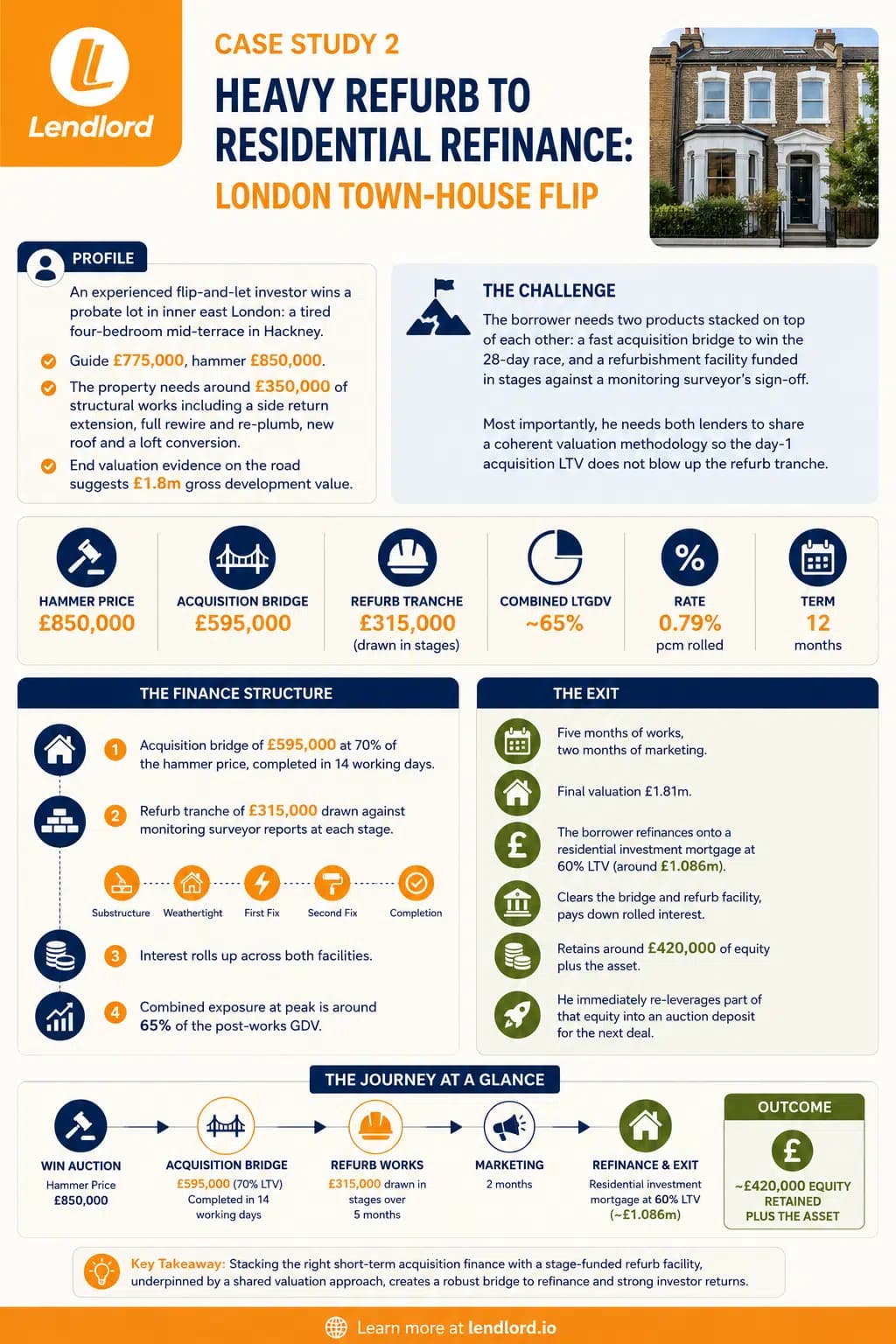
An experienced flip-and-let investor wins a probate lot in inner east London: a tired four-bedroom mid-terrace in Hackney. Guide £775,000, hammer £850,000. The property needs around £350,000 of structural works including a side return extension, full rewire and re-plumb, new roof and a loft conversion. End valuation evidence on the road suggests £1.8m gross development value.
The Challenge
The borrower needs two products stacked on top of each other: a fast acquisition bridge to win the 28-day race, and a refurbishment facility funded in stages against a monitoring surveyor's sign-off. Most importantly, he needs both lenders to share a coherent valuation methodology so the day-1 acquisition LTV does not blow up the refurb tranche.
Hammer price£850,000Acquisition bridge£595,000Refurb tranche£315,000 (drawn in stages)Combined LTGDV~65%Rate0.79% pcm rolledTerm12 monthsThe Finance Structure
Acquisition bridge of £595,000 at 70% of the hammer price, completed in 14 working days. Refurb tranche of £315,000 drawn against monitoring surveyor reports at each stage (substructure, weathertight, first fix, second fix, completion). Interest rolls up across both facilities. Combined exposure at peak is around 65% of the post-works GDV.
The Exit
Five months of works, two months of marketing. Final valuation £1.81m. The borrower refinances onto a residential investment mortgage at 60% LTV (around £1.086m), clears the bridge and refurb facility, pays down rolled interest and retains around £420,000 of equity plus the asset. He immediately re-leverages part of that equity into an auction deposit for the next deal.
Analysis
- Stack the products before you bid. Buyers who try to bolt on a refurb facility after the acquisition bridge has completed almost always end up paying a higher blended rate.
- GDV-based pricing rewards experience. Without two completed flips on the borrower's CV, the LTGDV would have been 60% rather than 70%.
- The "ratchet" matters. A clean monitoring surveyor process keeps the refurb drawdowns moving and protects margin against cost overruns.
Case Study 3 - 3-bed to 6-bed HMO conversion: Midlands provincial town
Profile
A landlord with five existing HMOs spots a tired three-bedroom semi in a strong student lettings catchment near Leicester. The road already has multiple HMOs and the property sits within an Article 4 direction area, so an HMO planning consent has been obtained on a prior application. Guide £225,000, hammer £262,000. Projected GDV as a 6-bed licensed HMO is £500,000.
The Challenge
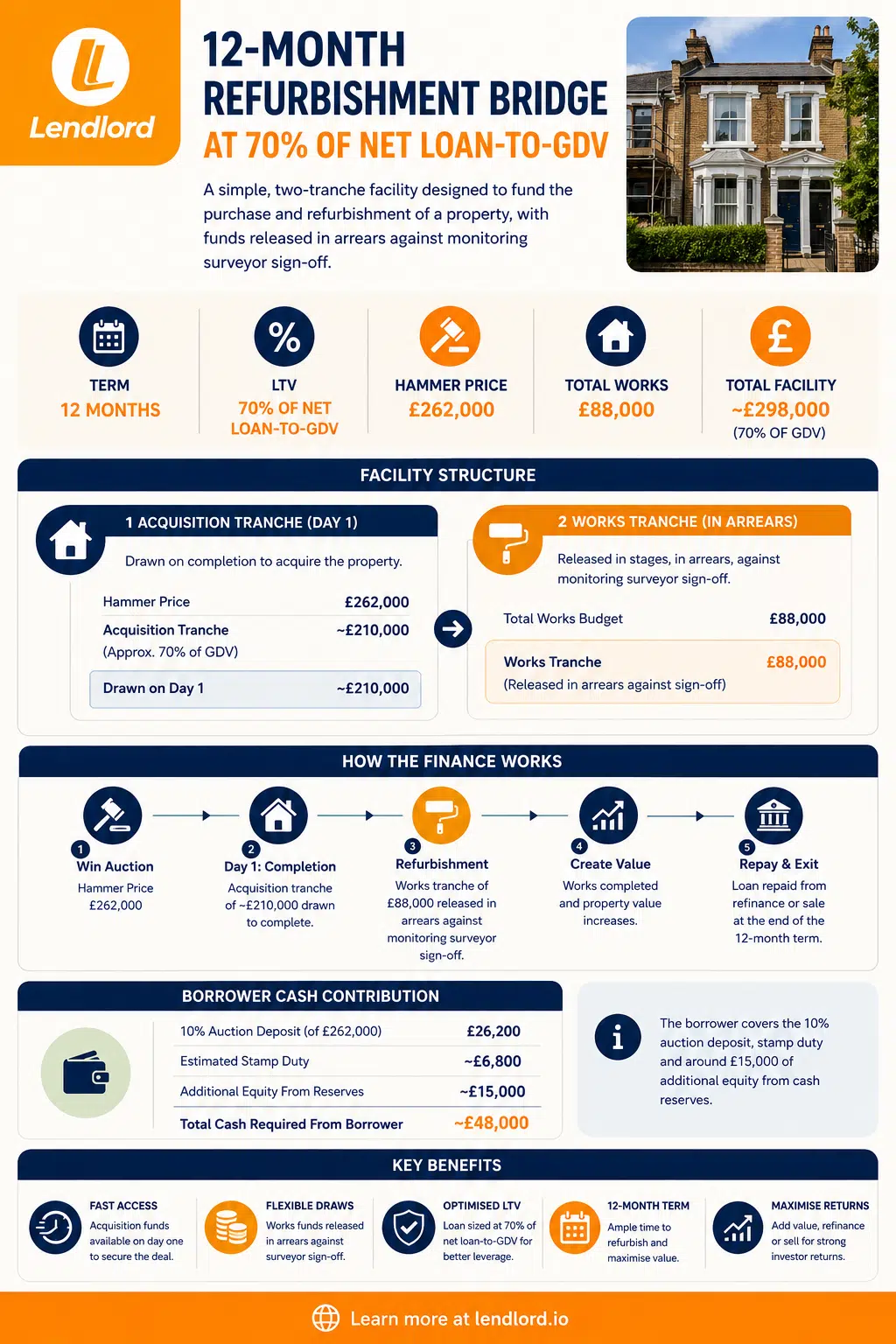
The borrower needs a single 12-month facility that funds the £262,000 acquisition and roughly £88,000 of works to convert the property to six en-suite letting rooms with a shared kitchen. Mainstream BTL lenders will not fund the conversion. The exit is a specialist HMO BTL mortgage, but that lender needs to see a finished, licensed, fully tenanted product before it will commit.
Hammer price£262,000Gross facility£315,000Net LTGDV70%Term12 monthsTime to drawdown3 weeksProjected GDV£500,000The Finance Structure
A 12-month refurbishment bridge at 70% of net loan-to-GDV. The acquisition tranche of around £210,000 (against £262,000 hammer) is drawn on day one, with the £88,000 works tranche released in arrears against monitoring surveyor sign-off. The borrower covers the 10% auction deposit, stamp duty and around £15,000 of additional equity from cash reserves.
The Exit
Eight months in, the HMO is fully let with six tenants at an average of £625 pcm per room (£3,750 gross monthly rent). The post-works valuation comes in at £490,000, just under the original GDV but easily strong enough for the exit. A specialist HMO BTL mortgage at 75% LTV releases £367,500, clearing the bridge and rolled interest with around £45,000 of "free equity" left in the asset.
Analysis
- Planning de-risks the entire deal. Buying a planning-consented HMO conversion is materially cheaper to finance than buying the planning risk yourself.
- Stress the exit valuation, not the cost projection. A 2% slip on rents can compress the BTL refinance enough to leave money trapped in the deal.
- Article 4 directions cut both ways. They restrict supply (boosting your exit rents) but raise the bar on planning. Always price both sides.
Case Study 4 - First-time landlord, permitted-development HMO: Greater Manchester
Profile
A first-time landlord - 32 years old, full-time PAYE in tech, no portfolio - identifies an opportunity in Oldham. Two adjoining ground-floor and first-floor flats in a former corner shop, sold as one lot. Guide £150,000, hammer £166,000. Both flats are currently uninhabitable. The plan is to combine them into a 6-bedroom HMO under permitted development rules (no planning consent required), letting to local NHS staff. End GDV around £370,000.
The Challenge
First-time landlords are a credit risk most BTL lenders price up heavily. The works themselves are non-trivial (structural opening, new staircase, plumbing, fire compartmentation). The borrower has £85,000 of cash savings and an inherited unencumbered flat worth £140,000 he can use as additional security. Without a creative structure he simply cannot make 28-day completion.
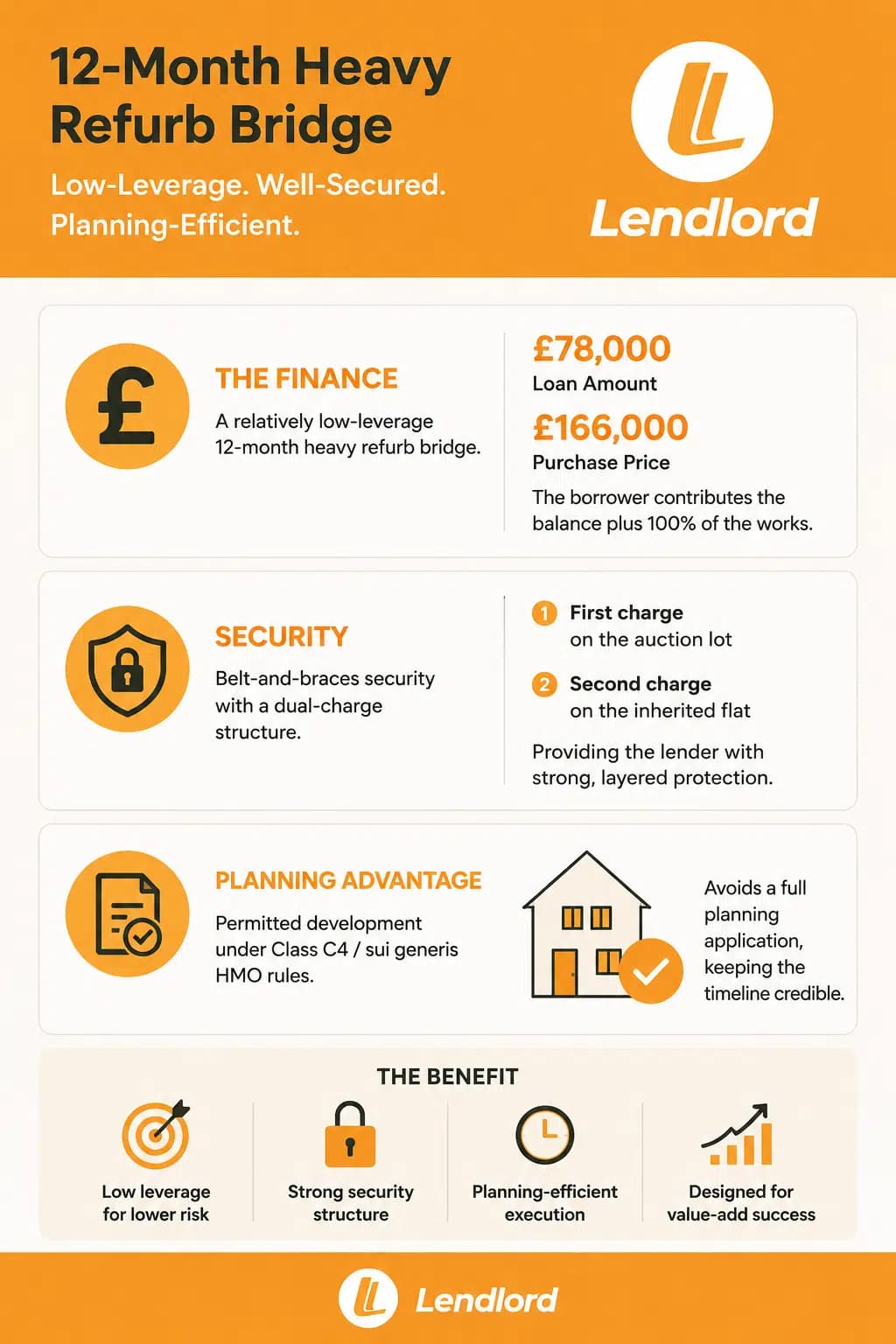
Hammer price£166,000Bridge (heavy refurb)£78,000LTV (purchase)47%Term12 monthsTime to drawdown22 daysProjected GDV£370,000The Finance Structure
A relatively low-leverage 12-month heavy refurb bridge: £78,000 against the £166,000 purchase, with the borrower contributing the balance plus 100% of the works. The lender takes a first charge on the auction lot and a second charge on the inherited flat as belt-and-braces security. Permitted development under Class C4 / sui generis HMO rules avoids a full planning application, keeping the timeline credible.
The Exit
Nine months later, the property is licensed, fully tenanted, and valued at £368,000. A specialist HMO BTL mortgage at 70% LTV (£257,600) clears the bridge, recovers all of the borrower's working capital and leaves around £30,000 of free equity. The inherited flat second charge is released.
Analysis
- First-time landlords are not automatically excluded from auction bridging. Lower LTV plus a strong second-charge security can offset thin experience.
- Permitted development is a quiet superpower. Skipping a planning application removes 8 to 16 weeks of timeline risk - exactly the timeline you do not have.
- Bundle the security, but document the release mechanism. The inherited flat charge must come off cleanly on refinance, or the borrower's exit is constrained for the next deal.
Case Study 5 - Modern Method of Auction rescue bridge: Home Counties BTL
Profile
A portfolio landlord with 11 BTL units bids on an MMoA lot in Berkshire: a 3-bedroom semi listed at £395,000 with what looks like a 56-day timeline. He wins at £412,000, pays a non-refundable reservation fee of just over £6,000, and lines up a BTL mortgage at 75% LTV with his usual lender.
The Challenge
At day 38 of 56, the BTL lender's surveyor down-values the property to £382,000 - around 7% below the agreed price. Three problems land at once: the mortgage advance drops to £286,500 (versus the £309,000 he had planned around), the LTV is now stuck above 80% of valuation if he keeps the price, and the 28-day exchange window inside the 56-day MMoA period is closing.
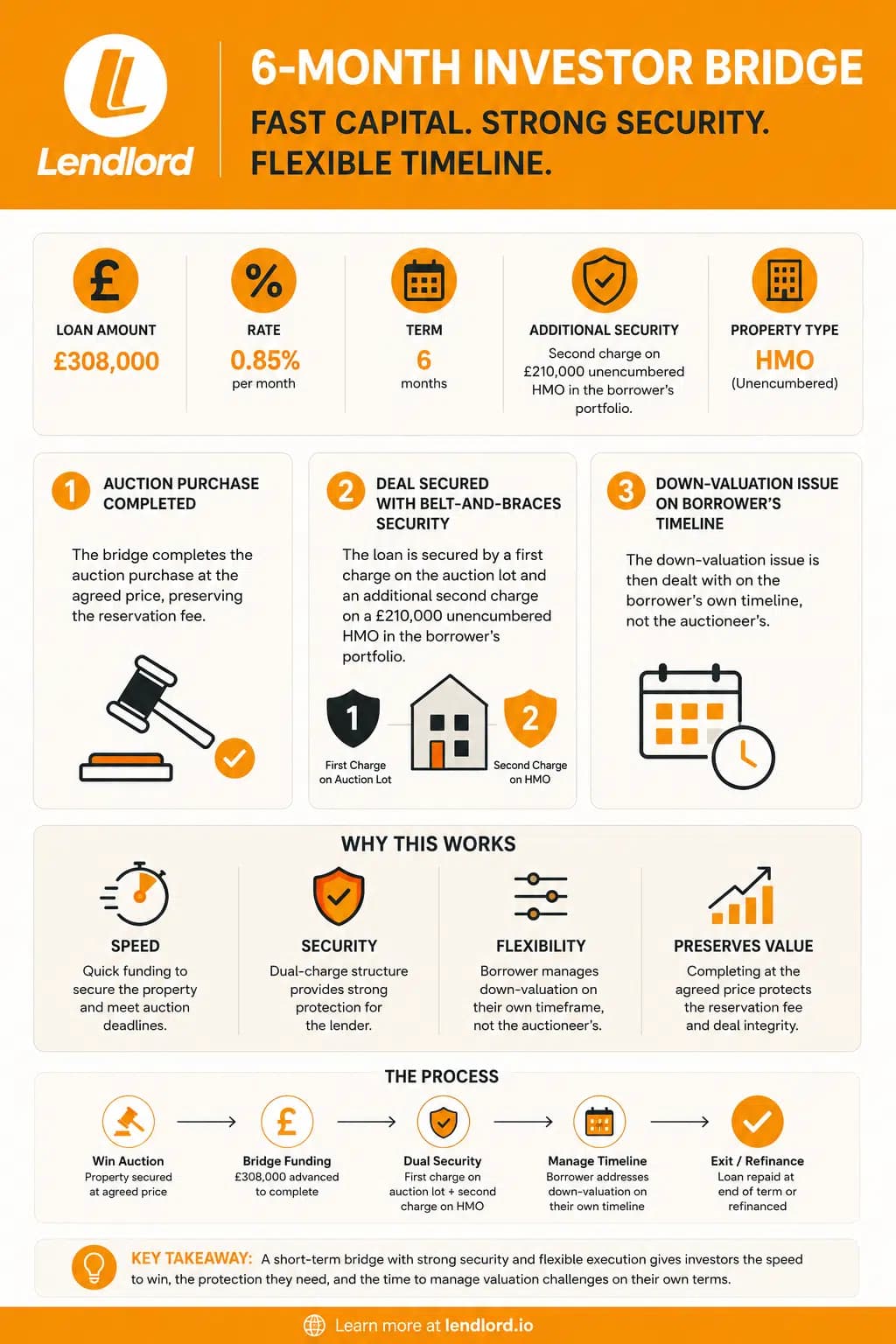
Hammer price£412,000Reservation fee at risk£6,180Rescue bridge£308,000LTV (hammer)75%Term6 monthsTime to drawdown8 working daysThe Finance Structure
A 6-month investor bridge of £308,000 at 0.85% per month, additionally secured by a second charge on a £210,000 unencumbered HMO in the borrower's portfolio. The bridge completes the auction purchase at the agreed price, preserving the reservation fee. The down-valuation issue is then dealt with on the borrower's own timeline, not the auctioneer's.
The Exit
The landlord commissions a second valuation through a different surveying firm. New valuation £405,000. He refinances onto a portfolio BTL mortgage at 75% of the new figure (£303,750), clearing the bridge with a small top-up from cash reserves. Total bridging cost: roughly £19,500 across six months and fees - a fraction of the £6,180 reservation fee plus 10% deposit he would have lost if the deal had collapsed at day 56.
Analysis
- MMoA does not eliminate timeline risk. A late down-valuation can implode the 56-day window just as effectively as it can implode a 28-day one.
- Cross-collateralised bridging is often the cheapest insurance. A small second charge on a strong portfolio asset lets the bridge clear quickly and protects future BTL relationships.
- The economics of "rescue" bridges are usually better than they look. Compare the all-in cost to the cost of losing the deposit plus reservation fee.
Case Study 6 - Class MA commercial-to-residential conversion: Kent office building
Profile
A small developer wins a vacant two-storey office building in a Kent commuter town. Guide £550,000, hammer £620,000. The site benefits from prior approval under Class MA (the Town and Country Planning permitted-development right that allows offices and certain commercial uses to convert to residential). The scheme is 6 self-contained one and two-bed flats, projected GDV £1.78m.
The Challenge
The borrower needs a facility that funds the auction completion and then transitions seamlessly into a development drawdown facility once works begin. Going to a pure development lender means missing the 28-day deadline. Going to a vanilla bridge means a second, costly refinancing event a few weeks later.
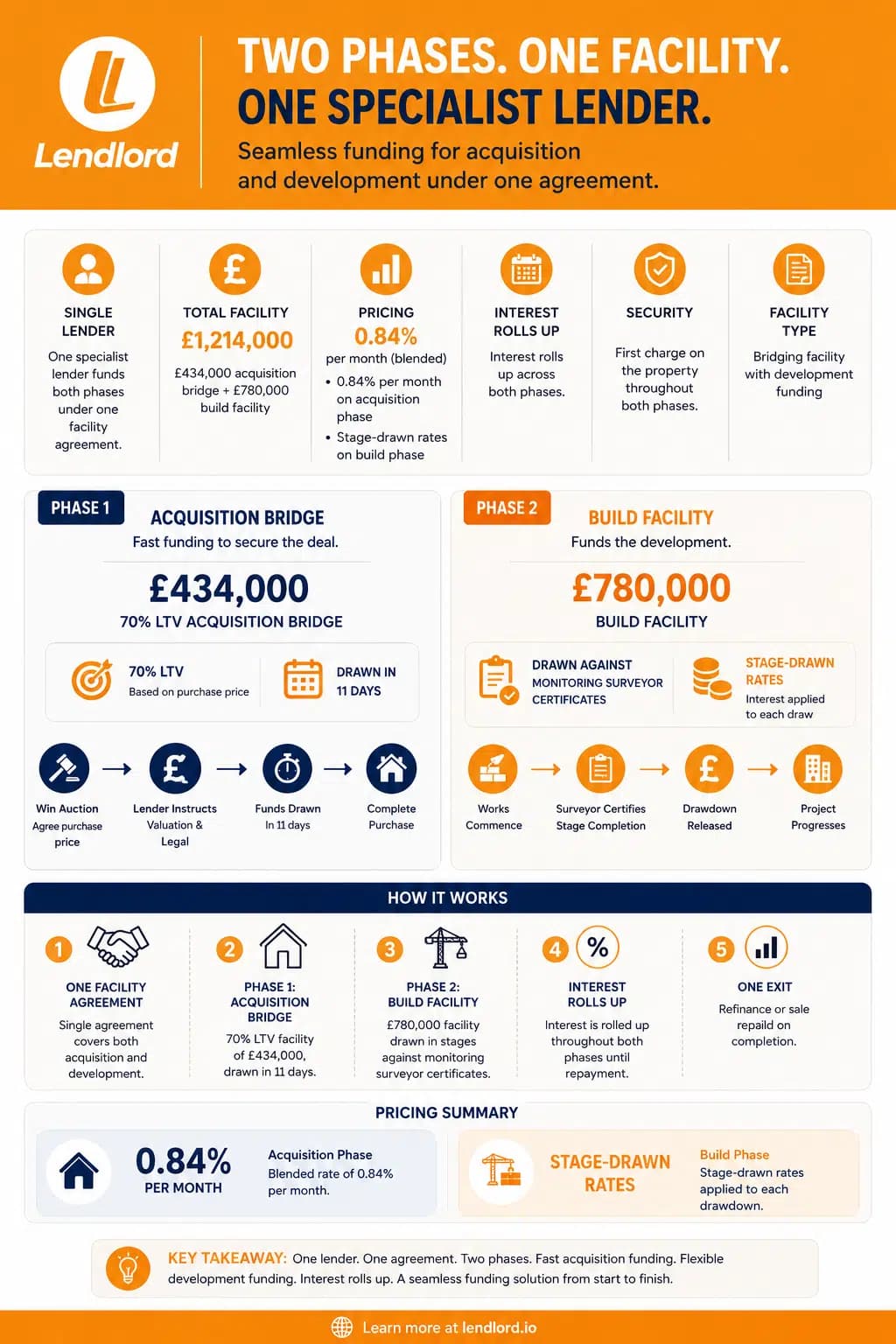
Hammer price£620,000Acquisition bridge£434,000Build facility (stage drawn)£780,000Peak LTGDV~64%Term18 monthsProjected GDV£1.78mThe Finance Structure
A single specialist lender funds both phases under one facility agreement. Phase 1: a 70% LTV acquisition bridge of £434,000, drawn in 11 days. Phase 2: a £780,000 build facility drawn against monitoring surveyor certificates. Interest rolls up across both phases. The pricing is a blended 0.84% per month for the acquisition phase and stage-drawn rates on the build phase.
The Exit
14 months later, 5 of the 6 flats are sold off-plan and on completion, generating £1.49m gross; the sixth is retained on a BTL mortgage at £295,000. Combined proceeds clear the facility and rolled interest, leaving the developer with the retained unit plus around £180,000 of cash profit.
Analysis
- The single-lender stack saves both money and timeline. Bridging plus separate development finance can work, but you pay for the refinance event.
- Class MA conversions are a sweet spot for specialist lenders. They love the planning certainty and the residential exit.
- Retain at least one unit if you can. A held flat on BTL stabilises the IRR even if the off-plan market softens.
Case Study 7 - Non-standard construction: concrete-built ex-council semi
Profile
An experienced flipper buys an ex-council semi in Cornwall at auction. The property is of non-standard construction (a recognised post-war pre-cast reinforced concrete system house). Hammer £128,000 against comparable brick stock at around £215,000. The plan is to re-clad the property in brick and lime render, modernise the interior and resell.
The Challenge
Pre-cast concrete designations are almost universally declined by mainstream lenders for refinance and onward sale. The borrower's edge is precisely that other buyers cannot finance the property in its current state. The bridge must therefore fund the purchase and the structural re-cladding works that make the property mortgageable on exit.
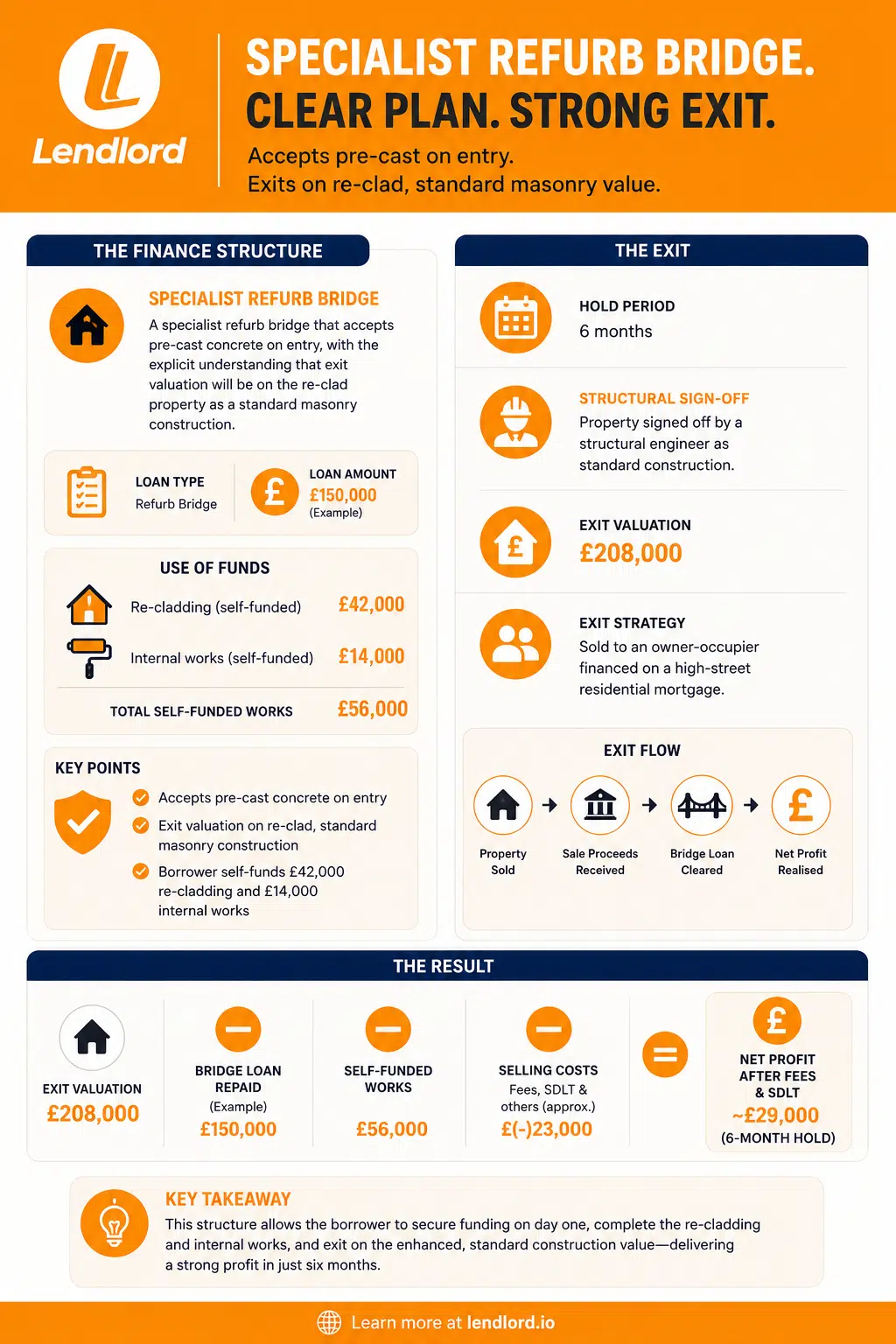
Hammer price£128,000Gross bridge£96,000LTV75%Term9 monthsRe-cladding cost£42,000Projected GDV£210,000The Finance Structure
A specialist refurb bridge that accepts pre-cast concrete on entry, with the explicit understanding that exit valuation will be on the re-clad property as a standard masonry construction. The borrower self-funds the £42,000 re-cladding plus £14,000 of internal works.
The Exit
Six months later, the property is signed off by a structural engineer as standard construction, valued at £208,000, and sold to an owner-occupier financed on a high-street residential mortgage. Bridge cleared from sale proceeds, net profit after fees and SDLT around £29,000 on a six-month hold.
Analysis
- Non-standard construction creates a price arbitrage. The discount versus brick comparables is structural and predictable.
- Pick a bridge lender who actively underwrites the construction type. A "yes" on entry that becomes a "no" on monitoring is fatal.
- Engineer's certification on exit is non-negotiable. Without it the exit lender will not accept the change in construction type.
Case Study 8 - Legal-pack landmines: defective title and short lease, South East
Profile
A mixed-use investor wins a former hostel lot in a South East coastal town at £1.18m. The legal pack reveals three problems on review: a 64-year residual lease on part of the upper floors, a missing Local Authority search caused by a council cyber-attack, and historic correspondence raising questions about whether the established use is genuinely C3 (residential) or remains C2 (hostel).
The Challenge
This is a deal that would terrify most buyers, but where a careful borrower can win exactly because so few competitors can finance it. The bridge lender must underwrite around the legal pack issues using title indemnity insurance, established-use evidence and a clear exit path that solves all three issues.
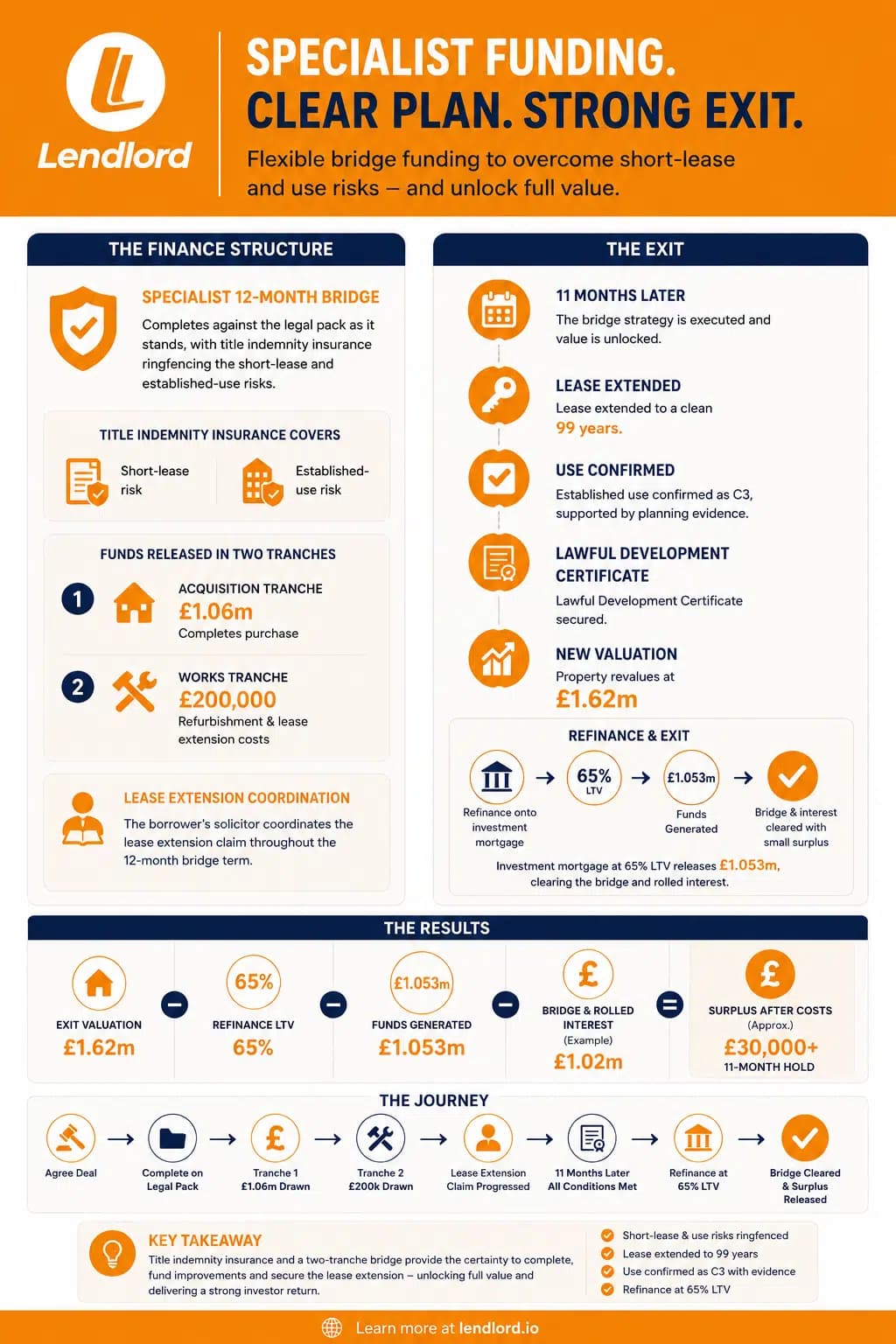
Hammer price£1,180,000Gross bridge£1,260,000 (incl. fees and works)LTV (purchase)~73%Term12 monthsLease extension cost~£85,000Time to drawdown21 working daysThe Finance Structure
A specialist 12-month bridge that completes against the legal pack as it stands, with title indemnity insurance ringfencing the short-lease and established-use risks. Funds are released in two tranches: a £1.06m acquisition tranche and a £200,000 works tranche for refurbishment and lease extension costs. The borrower's solicitor coordinates the lease extension claim during the bridge term.
The Exit
11 months later, the lease is extended to a clean 99 years, the established use is confirmed as C3 with planning evidence, and a Lawful Development Certificate is in hand. The property revalues at £1.62m and refinances onto an investment mortgage at 65% LTV, generating £1.053m which clears the bridge and rolled interest with a small surplus.
Analysis
- Reading the legal pack before bidding is the highest-return work in auctions. Three issues identified at bid stage are three issues priced into the offer.
- Title indemnity is a real underwriting tool, not a gimmick. A targeted policy can unlock lender appetite that would otherwise be absent.
- Lease extensions during the bridge term de-risk the exit valuation. Walk into the refinance lender with the new lease in hand.
Case Study 9 - Expat investor: Northern terrace bought from Singapore
Profile
A British couple working in Singapore want to extend their UK BTL portfolio. They bid by phone on a terraced house in Stafford, winning at £155,000. The plan is a light refurb plus a leasehold extension, then a BTL mortgage held in their existing UK SPV.
The Challenge
Expat applicants face a smaller lender panel, slower KYC processes (overseas address verification, source-of-funds documentation), and tighter pricing. Compressing that into a 28-day window requires a lender that already specialises in expat work.
Hammer price£155,000Gross bridge£125,000LTV70%Term7 monthsRefurb + lease extension£18,000Time to drawdown19 working daysThe Finance Structure
A 7-month expat bridge at 70% LTV with seven months of interest retained upfront, funding both the acquisition and around £18,000 of refurbishment plus lease extension costs. The borrowers complete KYC remotely through certified copies and a video call with the lender's underwriter.
The Exit
Six months later, the property is refurbished, the lease is extended and the unit is let at £950 pcm. The borrowers refinance onto a specialist expat BTL mortgage at 75% of the new £229,000 valuation, clearing the bridge with a healthy surplus and retaining strong gross rental yield.
Analysis
- Expat status is a panel issue, not a credit issue. Pick a lender that already underwrites your jurisdiction and you remove the friction.
- Bundle the lease extension into the bridge. Doing it during the bridge term saves a separate fee event and improves the exit valuation.
- Retained interest matters more when you are 6,000 miles away. The last thing you need is missed monthly servicing because of a time-zone mistake.
Case Study 10 - Repossession lot from a fixed-charge receiver: Yorkshire BMV deal
Profile
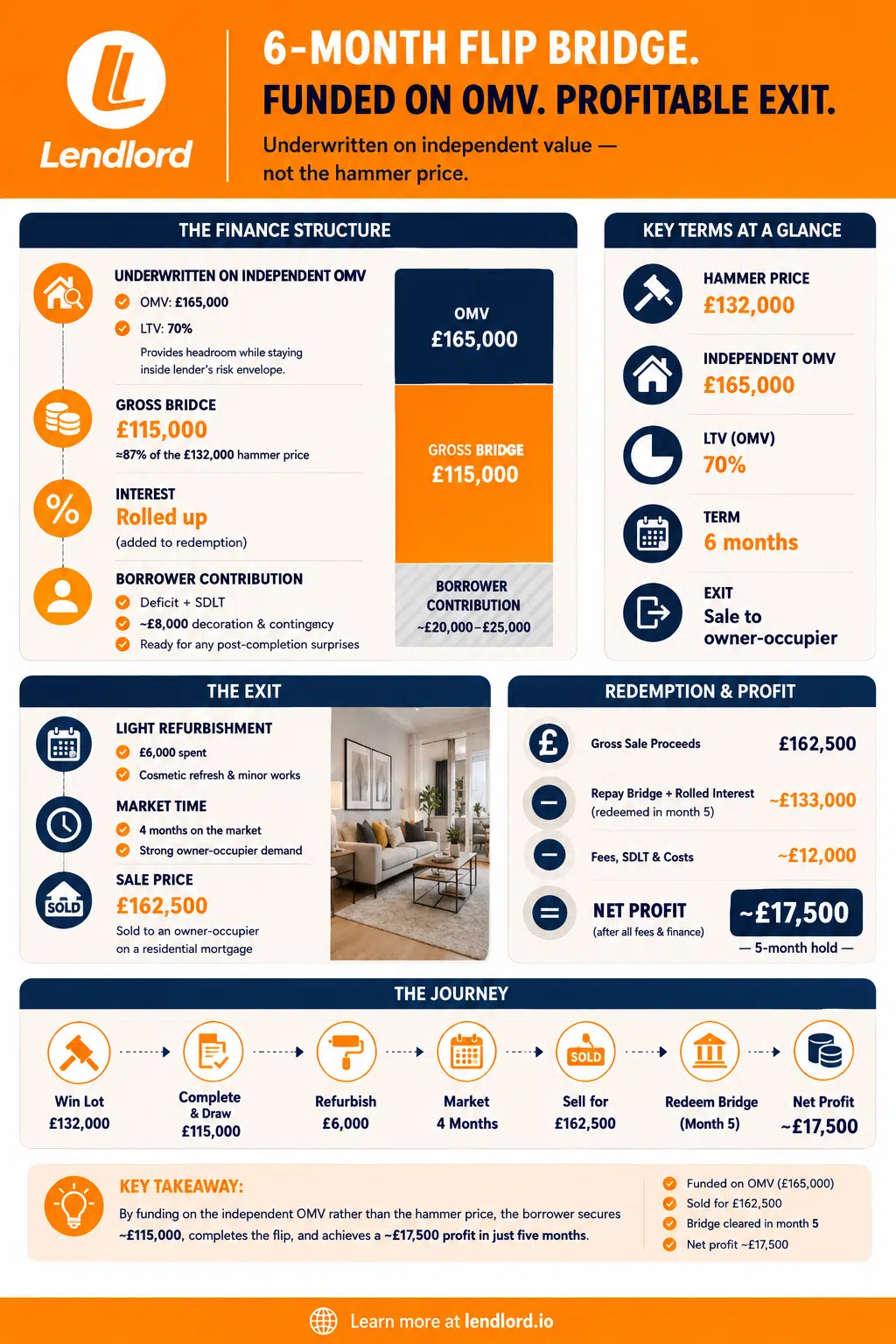
A trade buyer with a 22-property portfolio wins a 3-bed semi in West Yorkshire at auction. The lot has been instructed by a fixed-charge receiver appointed by a previous lender following the original owner's default. Open market value is around £165,000; hammer price £132,000 - a clear below-market-value purchase. The legal pack is bare: sold as seen, no warranties, no replies to enquiries, vacant possession on completion.
The Challenge
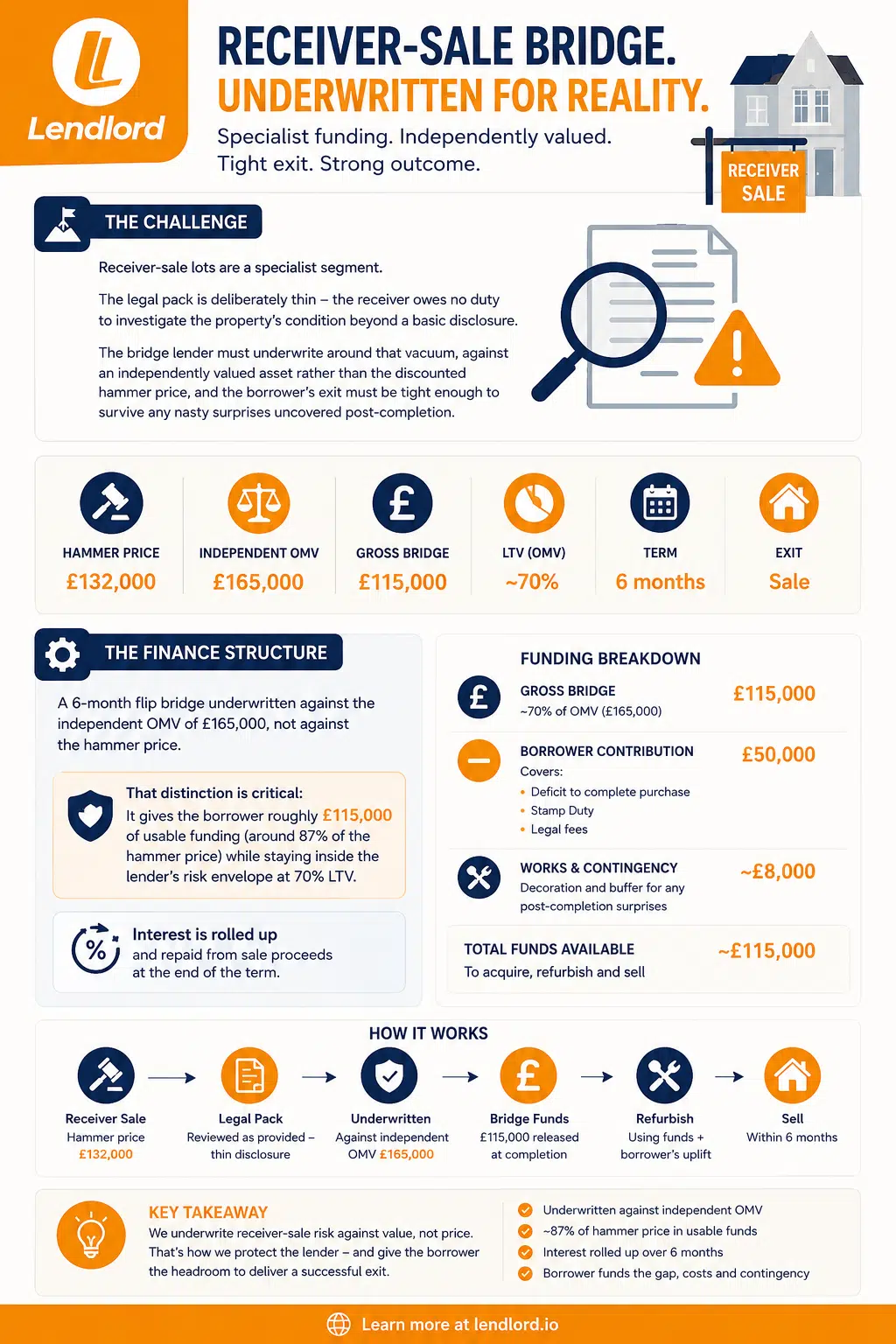
Receiver-sale lots are a specialist segment. The legal pack is deliberately thin - the receiver owes no duty to investigate the property's condition beyond a basic disclosure. The bridge lender must underwrite around that vacuum, against an independently valued asset rather than the discounted hammer price, and the borrower's exit must be tight enough to survive any nasty surprises uncovered post-completion.
Hammer price£132,000Independent OMV£165,000Gross bridge£115,000LTV (OMV)~70%Term6 monthsExitSaleThe Finance Structure
A 6-month flip bridge underwritten against the independent OMV of £165,000, not against the hammer price. That distinction is critical: it gives the borrower roughly £115,000 of usable funding (around 87% of the hammer price) while staying inside the lender's risk envelope at 70% LTV. Interest is rolled up. The borrower contributes the deficit plus stamp duty and around £8,000 of decoration and contingency funds for any post-completion surprises.
The Exit
The property turns out to be in better condition than expected. After £6,000 of light refurbishment and four months on the market, it sells for £162,500 to an owner-occupier on a residential mortgage. The bridge is redeemed in month 5. Net profit after all fees, SDLT and finance costs is around £17,500 on a five-month hold.
Analysis
- Receiver-sale lots are about the price arbitrage and the speed of the buyer. The 10% to 25% discount to OMV is real, but it exists because most buyers cannot complete inside the window.
- Independent valuation, not hammer price, sets the lender's leverage. Pick a lender that explicitly underwrites against OMV on receiver sales.
- Always price in a contingency. A bare legal pack means surprises; a small reserve fund keeps the project moving.
Five lessons brokers and investors should take from these cases
Across the ten case studies, a handful of recurring themes explain why some auction purchases run smoothly while others stall. They are simple but rarely fully implemented.
1. Source the lender before you source the lot
The strongest buyers in any auction room have already done their lender selection. They have a Decision in Principle for auction bridging loan exposure at the LTV bands they typically use, they have completed KYC, and they know which valuer panel their lender works with. When the catalogue drops, they are pricing lots; everyone else is pricing lenders.
2. Read the legal pack like it owes you money
Case 8 shows it plainly: the legal pack is where the deal is won or lost. Short leases, missing searches, restrictive covenants, established use questions, chancel repair liability - all of these will either kill the deal post-bid or get priced in pre-bid. The cost of a 30-minute pre-auction call with your solicitor on every catalogue lot you might bid on is the highest-ROI work in the entire process.
3. Stack acquisition and works under one facility wherever possible
Cases 2, 3, 4, 6 and 8 all use bridge structures that fund both the auction completion and the post-completion works inside one facility. That removes a refinance event mid-project, reduces total set-up fees, and gives the monitoring surveyor a single brief. Two separate facilities is sometimes the only option, but it is rarely the cheapest.
4. Underwrite to the exit, not the entry
Every successful case has a clear, documented exit. Cases 1, 3, 4 and 9 exit onto specialist BTL mortgages; Cases 2 and 8 exit onto residential investment refinances; Case 6 exits onto sales plus a retained BTL; Cases 7 and 10 exit onto open-market sale. The lender's question on day one is "what redeems my facility?" - if you cannot answer that on a single sheet of paper, you do not have a deal.
5. Use the right comparison tool early
Pricing varies far more than borrowers realise. On a £400,000 12-month bridge, a 25 bps difference in monthly rate is £12,000 of interest. Run multiple scenarios through the dynamic bridging loan calculator, and look at a wider bridging loan calculators comparison across the major specialist lenders before you commit. Marginal price improvements compound across a portfolio.
Fast bridging in practice
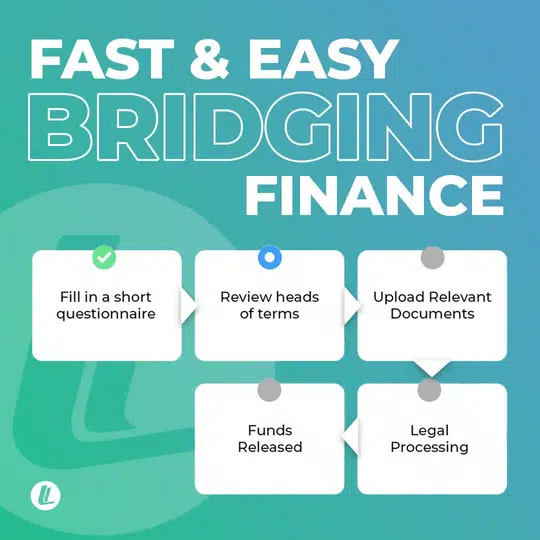
None of this works if the actual mechanics of fast bridging are slow. The realistic 7 to 14 day turnaround for an auction-ready facility depends on three things: a lender that prices to win, a borrower with documents ready before they bid, and a solicitor who has handled this specific lender's legal pack before. When those three are aligned, completion within the 28-day window becomes routine rather than heroic.
Once a borrower has run a fast bridging finance case once, the second auction lot is materially easier: the KYC pack is already on file, the lender knows the borrower, and the solicitor has a template. By the third lot, completion within the 28-day window is essentially a checklist exercise. Pair that operational rhythm with a steady stream of auction properties and the strategy scales.
Why investors choose Lendlord for auction bridging finance
Every case study above shares a common thread: the speed, structure and flexibility of the bridge made the deal possible. Here is what Lendlord brings to auction-day buyers specifically.
- High Leverage
Access up to 90% of the purchase price (up to 75% of market value). Case Study 4 shows how lower personal equity can still win the 28-day race when the asset and exit stack up. - All-in-One Funding
Cover both purchase and refurbishment costs in a single, streamlined package - exactly the structure used in Cases 2, 3, 6 and 8 where splitting the facility would have added cost and timeline risk. - Strategic Flexibility
Purpose-built for flips, BRRR strategies, or closing funding gaps quickly. Whether your exit is a sale (Cases 7 and 10), a BTL refinance (Cases 1, 3, 4, 9) or a development sell-down (Case 6), the facility flexes to match. - Rapid Decisions
Receive indicative terms within minutes and Heads of Terms within hours, helping you move quickly on opportunities. In a market where catalogues drop four to six weeks before the sale, early certainty on pricing is a competitive advantage. - Fast Auction Completions
Designed for auction purchases, with completions possible within days or weeks to help meet strict auction deadlines. Case Study 5 completed a rescue bridge in 8 working days; Case Study 1 funded in 12. - Dual Legal Representation
Both you and the lender can use the same solicitor, cutting down red tape and moving your deal to completion in record time. One solicitor acting for both sides can shave 5 to 7 days off the legal process. - Direct Lender Bridging - No Broker Fees
Lendlord lends directly. No broker layer means no intermediary fees, faster communication and a single point of contact from application to redemption. - Dedicated Auction Specialists
Speak to dedicated auction finance specialists on a video call or by phone - real underwriters who understand the 28-day clock, not a generic call centre.
The 10 cases at a glance
Auction finance FAQ
Auction finance is typically a short-term bridging loan used to fund the purchase of a property bought at auction. After the hammer falls you pay a 10% deposit and must complete within 28 days on a traditional unconditional auction (or 56 days on a Modern Method of Auction). The bridging lender underwrites the property and the borrower's exit (refinance or sale), funds the balance of the purchase price, and is redeemed when the borrower refinances onto a longer-term mortgage or sells the asset.
What is a bridging loan for auction property?A bridging loan for auction property is a short term bridging loan specifically structured to meet auction completion timelines. It can be drawn down in days rather than weeks, can be priced on properties that mainstream lenders refuse (unmortgageable, non-standard construction, short lease, defective title), and is repaid through a pre-agreed exit, usually a remortgage or a sale.
Can I get a bridging loan for auction property?Most investor borrowers can. Specialist auction finance lenders focus more on the property, the exit strategy and the borrower's experience than on income. First-time landlords, expats, and investors with adverse credit history all have routes to auction bridging loan finance, although pricing and LTV will vary.
How to complete on auction property in 28 days?Complete on auction property in 28 days by lining up your finance, solicitor and valuer before you bid. Have an Agreement in Principle from a specialist lender, give your solicitor the auction legal pack the moment it is published, and instruct a same-day valuation as soon as the hammer falls. A well-prepared buyer can move from "winning bid" to "funds released" inside 7 to 14 working days, leaving comfortable margin against the 28-day deadline.
Best bridging loan for auction property?The best bridging loan for auction property is the one whose pricing, LTV and turnaround match your specific lot and exit. A cheap rate on a slow process is no use if you miss the 28-day deadline. Always benchmark at least three specialist lenders on rate, fees, day-1 LTV, day-1 LTGDV (for refurbs), exit fee policy and time-to-funds.
How quickly can auction finance be arranged?Realistically, auction finance in 7 days is achievable on simple residential lots where the borrower has KYC complete and the legal pack is clean. More complex lots (commercial, non-standard construction, defective title) take 10 to 21 working days. The bottleneck is rarely the lender's credit decision; it is usually the legal process and valuation.
Can I refinance an auction bridging loan onto a mortgage?Yes, and this is the most common exit. The vast majority of auction bridges are designed to be refinanced onto either a buy-to-let mortgage (for held investment property) or a residential mortgage (when the property is being sold to an owner-occupier and the bridge clears from sale proceeds). The exit is agreed in principle before the bridge is drawn.
What deposit do I need for auction finance?For most auction bridging loan products, expect to fund 25% to 30% of the purchase price from your own resources. That comprises the 10% auction-day deposit plus an additional 15% to 20% paid on completion, alongside SDLT, lender fees and any refurbishment contingency. Some specialist lenders fund up to 90% of purchase price (e.g. when additional security is offered), but 70% to 75% LTV is the standard band.
Bridging loan for uninhabitable property at auction?This is exactly what auction bridging is built for. Mainstream BTL and residential lenders will refuse a property without a functional kitchen, bathroom or weathertight envelope. A bridge funds the purchase and (often) the works required to make the property mortgageable, after which the borrower refinances or sells. See Case Study 1 above for a worked example.
Is there an auction finance calculator?Yes. The Lendlord dynamic bridging loan calculator models loan amount, LTV, term, rate, arrangement fee and total repayable specifically for auction finance scenarios. For a wider bridging loan calculators comparison across the major specialist lenders, this gives you a like-for-like view across the market.
Stamp duty auction property calculator and ROI calculator - do they help?A stamp duty auction property calculator helps you back-out the true acquisition cost (purchase price + SDLT including the second-home surcharge and any non-resident uplift, plus auction fees and legal costs). An auction property ROI calculator goes further, modelling gross yield, net yield, and projected IRR taking refurbishment, void and finance costs into account. Both are essential before you bid, not after.
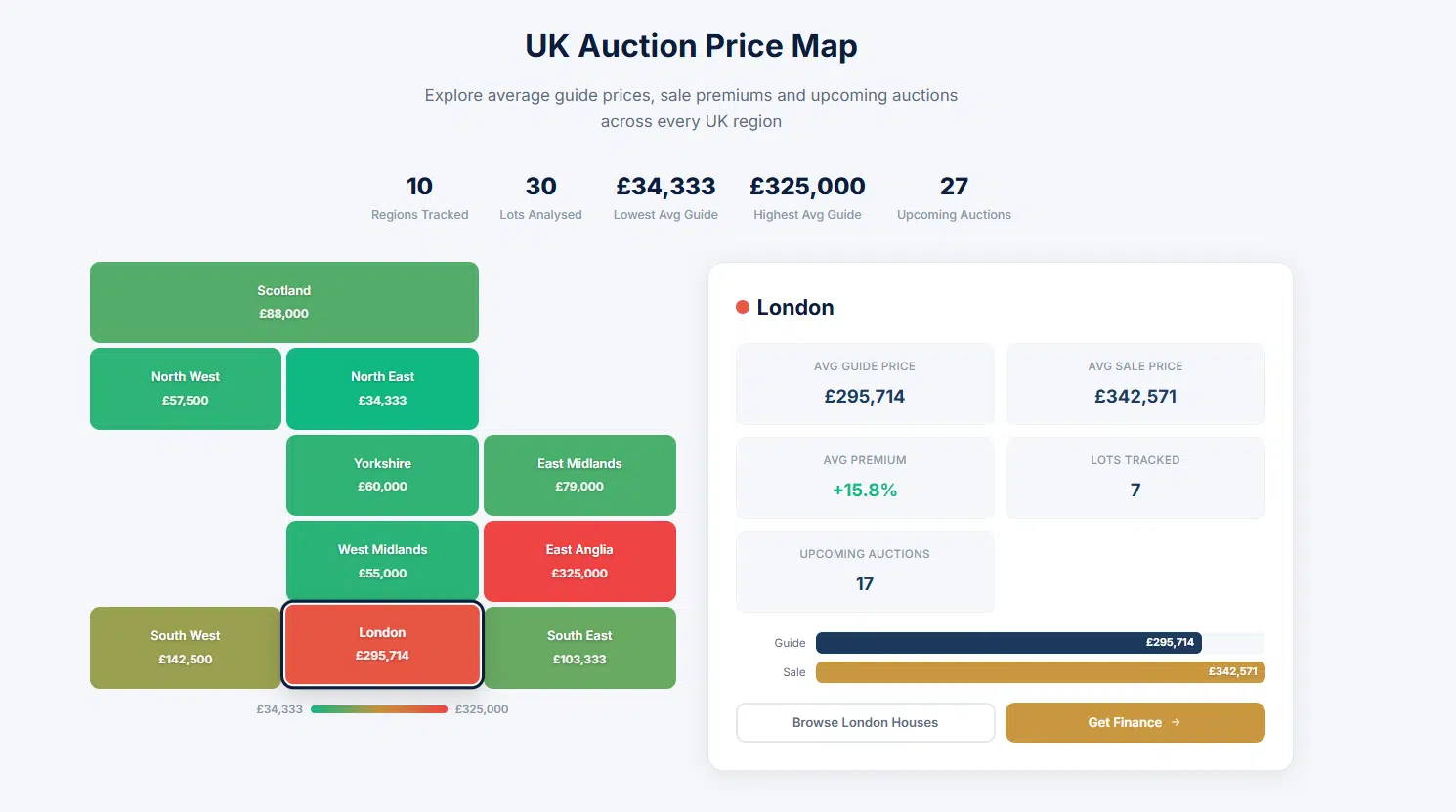
Where can I find live auction lots?The big national auctioneers publish their catalogues four to six weeks before each sale. Aggregated views of upcoming UK auction properties can help shortlist faster across multiple auctioneers, and the UK Auction Calendar shown above is a good starting point for catalogue release dates.
Methodology and disclaimer. The ten case studies in this article are illustrative composite scenarios drawn from common patterns in published lender case files and broker market activity. They are not specific borrowers, not specific lenders, and not committed loans. Figures are rounded for clarity and shown in pounds sterling. Rates, LTVs and fees referenced reflect representative 2026 specialist lending bands and will vary by case. Nothing in this article constitutes financial, legal or tax advice. Always seek qualified professional advice before acting on any property finance decision.
Related resources on Lendlord
- Dynamic bridging loan calculator - model your auction bridge in real time.
- Bridging loan calculators comparison - benchmark the major specialist lenders.
- Auction properties - live UK auction lots, aggregated.