Renters' Rights Act Information Sheet 2026: How to Prove Delivery and Avoid Fines
Published · Updated · 5 min read
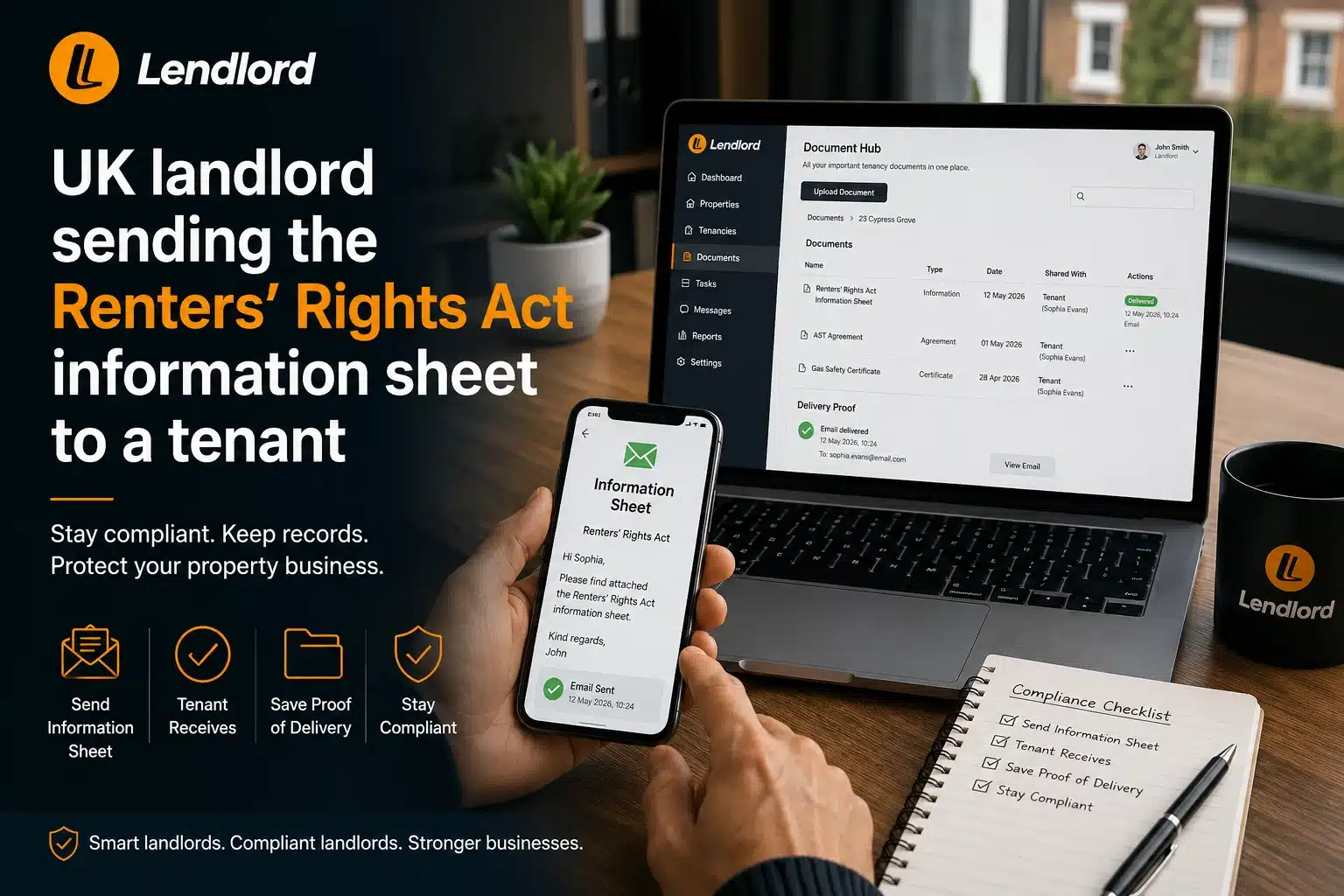
If you manage UK rentals in 2026, the Renters Rights Act information sheet 2026 should already be on your compliance checklist. In fact, searches for renters rights act information sheet and even the misspelling renters right act information sheet have surged because fines reach £7,000.
Why proof of delivery matters as much as sending the sheet
However, sending the sheet is only step one. Proving delivery is what protects you when a tenant claims they never received it. Therefore, treat delivery records with the same care as deposit protection paperwork.
Additionally, councils will ask for evidence when investigating complaints. A note in your phone that you handed it over will not survive scrutiny on its own.
Key facts at a glance
- Penalty: Up to £7,000 for missing or unproven delivery
- Deadline: Existing tenants by 31 May 2026
- Best proof: E-signature or in-app acknowledgment
- Storage: One record per tenancy, searchable on demand
Quick watch: RRA information sheet essentials
What the information sheet covers
The government published the Renters' Rights Act Information Sheet to explain tenant rights under the new framework. Every UK landlord must give a copy to each tenant. The sheet itself is free. Still, the cost of getting delivery wrong is not.
Meanwhile, enforcement teams linked to the PRS database will expect documentary evidence. For that reason, build proof of delivery into your standard tenancy workflow from day one.
Acceptable proof of delivery methods
First, rank your options from strongest to weakest: e-signature through a tenancy platform, in-app acknowledgment with timestamp, recorded delivery with tracking, hand delivery with signed receipt, and plain email (only if you can prove receipt).
Specifically, Lendlord's guide on how to send the Renters Rights Act information sheet walks through the free sharing tool that captures acknowledgment automatically.
How to serve the information sheet legally in seven steps
For a full compliance walkthrough, follow our article on how to serve the information sheet legally in seven steps. It covers identifying every tenancy, downloading the official document, serving each named tenant, and securing robust proof.
In addition, missing one named tenant on a joint tenancy can invalidate your entire compliance file. Consequently, check every name on the agreement before you close the file.
What the information sheet means for your tenancies
Understand the content, not just the delivery. Our explainer on what the information sheet means for landlords breaks down how periodic tenancies, Section 13 rent increases, and possession grounds interact with the rights your tenant now expects in writing.
Watch: post-RRA compliance for UK landlords
What to store in a council-ready compliance file
Store one folder per tenancy with: the signed periodic agreement, Information Sheet proof, deposit protection certificate, gas safety, EICR, and EPC. When a council officer requests records, you want a single export, not a weekend of email searching.
How Document Hub keeps proof searchable
Lendlord Document Hub timestamps every upload and links documents to the correct property and tenant. As a result, if a dispute arises years later, you pull the delivery record in seconds rather than reconstructing events from memory.
Common mistakes that trigger fines
- Serving only one tenant on a joint tenancy
- Using an outdated or unofficial version of the sheet
- Relying on verbal confirmation without written proof
- Missing the 31 May 2026 deadline for existing tenants
- Storing records in personal email with no backup
Each of these is preventable with a structured process and the right tools. Therefore, fix gaps before a complaint lands on your desk.
Short: five RRA compliance must-knows
Five steps to audit and re-serve this week
If your records have gaps, start here. In practice, most landlords can close compliance holes in one focused review session.
- Audit every tenancy. List all named tenants and check who received the sheet.
- Re-serve where proof is weak. Better to serve twice with proof than once without.
- Download the official document. Avoid third-party summaries that may miss updates.
- Use e-signature where possible. Strongest evidence for tribunal or council review.
- Centralise records. Upload everything to Document Hub with property tags.
Compliance is not glamorous. Even so, it is what keeps you renting when less prepared landlords sell up. In short, get the paper trail right once and every future tenancy follows the same template.
Joint tenancies and HMO households
On joint tenancies, every named tenant must receive the sheet individually. One signature from the lead tenant is not enough. Similarly, in HMOs, serve each occupier with contractual responsibility, not just the head tenant on the agreement.
Councils investigating HMOs will ask for room-level records. For that reason, log delivery by room or unit where several tenants share one property.
Student lets and tenant changeovers
Student lets transitioning between academic years need particular care. If one tenant leaves and another joins, confirm whether a new periodic agreement started and whether fresh service is required. When in doubt, re-serve with proof.
Verbal tenancies and legacy agreements
Landlords with verbal agreements must still serve the sheet and issue a written statement confirming terms. The Information Sheet does not replace a written contract, but delivery proof applies equally.
Additionally, log the date, method, and witness if you hand deliver to a tenant without email access. That small step can save you during a later dispute.
Preparing for council inspections in 2026
Enforcement teams funded by PRS database fees will have more capacity to investigate. When an officer visits, they may request Information Sheet proof alongside gas safety and deposit records.
Ultimately, a searchable Document Hub export beats printing folders on the morning of inspection. Treat every tenancy as if it will be audited, because prepared landlords pass reviews without panic.
Digital vs paper delivery records
Paper records fade and post gets lost. By contrast, digital delivery through a tenancy platform creates a timestamped audit trail courts and councils prefer.
If you must use post, pay for signed delivery and photograph the receipt before posting. Finally, upload the tracking confirmation to Document Hub the same day so the record matches the send date.
Short: compliance tool for Information Sheet delivery
Send the Information Sheet with timestamped proof of delivery and store every record in one compliance hub.
Manage documents with Document HubFrequently asked questions
What counts as proof of delivery for the RRA information sheet?
In practice, the strongest proof includes e-signature or in-app tenant acknowledgment with a timestamp. Additionally, email read receipts, recorded post, and hand-delivery with a signed receipt also work if executed correctly.
What is the deadline to serve the information sheet?
For existing tenants, the deadline was 31 May 2026. Meanwhile, new tenancies require service at the start. Consequently, late or missing delivery risks civil penalties up to £7,000.
Can I email the Renters Rights Act information sheet?
However, email alone is weak unless you can prove the tenant received and acknowledged it. Therefore, use a tool that captures acknowledgment or e-signature rather than a plain PDF attachment.
What if a tenant refuses to sign?
First, document every attempt. Next, serve by recorded delivery, retain the tracking number, and log the date. Ultimately, councils expect a clear audit trail showing you took reasonable steps.