EPC C by 2030: Where Landlords' Recorded Ratings Stand, Region by Region
Published
6 min read
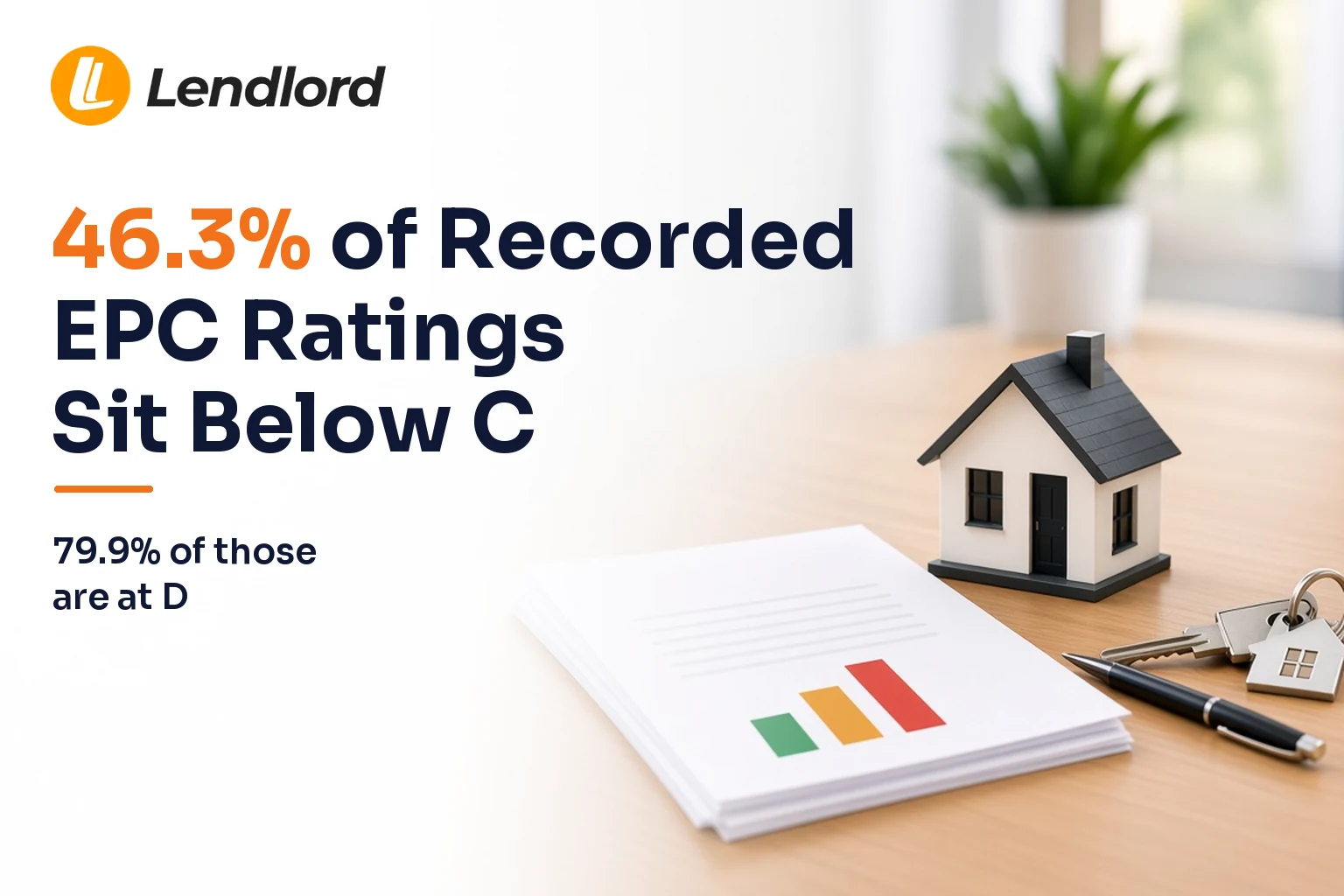
Of homes with a band recorded, 46.3% sit below C. Of the homes below C, 79.9% are at D, one band short.
On 4 November 2026 the government published the Energy Independence Bill factsheet. The Bill would set a new maximum civil penalty of £30,000. EPC C is confirmed from 1 October 2030, or a registered exemption. The minimum energy efficiency standard today is still E.
Figures last checked 14 November 2026. Lendlord figures from accounts approved for disclosure: recorded EPC bands on let homes in England and Wales, as at 31 October 2026. 26.7% of let homes have a band recorded. The shares below are of those homes.
What the Bill changes, and what it does not
The recorded EPC band is the band a landlord entered from the certificate. The minimum energy efficiency standard is the lowest band a let home may sit at. Today that standard is E. The maximum required investment is the most that has to be spent on a home before an exemption can apply. Today that cap is £3,500 including VAT, to reach E.
The factsheet restates two decisions from 21 January 2026. The standard rises to C on 1 October 2030. The cap for that step is confirmed at £10,000 per home. The Bill would add a new maximum civil penalty of £30,000, three times the 2030 cap.
It would also let the government require houses in multiple occupation to comply with the same Regulations, and it would give councils enhanced enforcement and compliance powers. None of the Bill's measures is law until Royal Assent.
A home at D or E may be let today, because the minimum is E. A home at F or G needs a registered exemption to be let. Price the step to C.
| Rule | Today | Confirmed, or in the Bill |
|---|---|---|
| Minimum energy efficiency standard | E | C from 1 October 2030, or a registered exemption |
| Maximum required investment | £3,500 including VAT, to reach E | £10,000 per home, to reach C from 1 October 2030 |
| Civil penalty | Set in the 2015 Regulations | The Bill would set a new maximum of £30,000 |
| Houses in multiple occupation | Covered where the home must have an EPC and is let on a qualifying tenancy | The Bill would let the government require them to comply |
| Council enforcement powers | As the Regulations stand | The Bill would give enhanced enforcement and compliance powers |
Source: GOV.UK factsheet on domestic private rented enforcement, published 4 November 2026. It restates the January confirmation.
For costs, grants and exemptions, read the 2030 rules and funding routes.
How far recorded ratings are from C
These are the shares for that recorded subset, on the same snapshot.
| Band | Share |
|---|---|
| A | 3.7% |
| B | 5.6% |
| C | 44.4% |
| D | 37.0% |
| E | 8.7% |
| F | 0.4% |
| G | 0.2% |
Source: Lendlord accounts approved for disclosure, same snapshot as the stamp.
Start with D. It is 37.0% of that subset, and 79.9% of the homes below C. F is 0.4% and G is 0.2%. Leave those two in the table.
On the home
See which certificates are missing or out of date
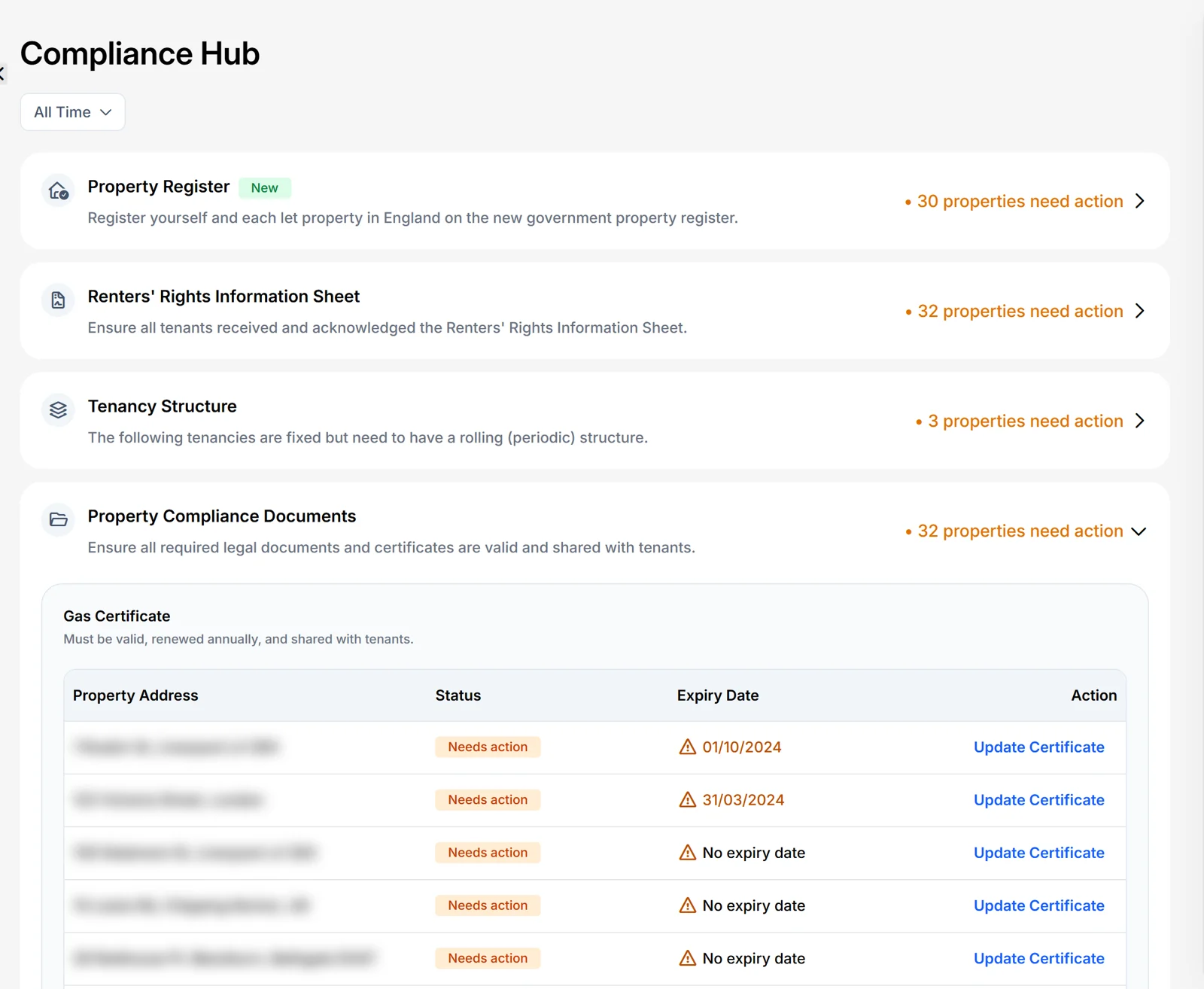
Record each home's certificate and its expiry date before you price any works.
Open the compliance hubRegion by region
The gap between Yorkshire and the Humber and the South West is 16.7 percentage points. Wales, at 51.8%, is a smaller group of recorded homes, as is the South West. Read those shares. Do not treat them as league places.
| Region | Share below C |
|---|---|
| Yorkshire and the Humber | 53.9% |
| Wales | 51.8% |
| East Midlands | 48.9% |
| East of England | 48.4% |
| North East | 46.6% |
| North West | 46.6% |
| West Midlands | 45.6% |
| South East | 44.4% |
| Greater London | 40.3% |
| South West | 37.2% |
Source: same snapshot. Each share uses the recorded subset in that region.
The next step is the same in every region. Get the certificate for each home.
Portfolio size makes less difference than place
Portfolio size moves the below-C share less than region does. The table runs from 43.7% on portfolios of 4 to 10 homes to 49.4% on portfolios of 21 or more. These size bands cover all UK regions. The regional table covers England and Wales only.
The recording rate is the wider gap. Landlords with 1 to 3 homes record a band on 8.5% of homes. Larger portfolios record a band on 26.0% to 29.6% of homes. Write the band down before you compare regions.
| Portfolio | Share below C | With a band |
|---|---|---|
| 1 to 3 homes | 45.4% | 8.5% |
| 4 to 10 homes | 43.7% | 26.0% |
| 11 to 20 homes | 44.1% | 29.6% |
| 21 or more homes | 49.4% | 27.4% |
Source: same snapshot. Below-C shares use the subset. The third column is of all homes in that size band.
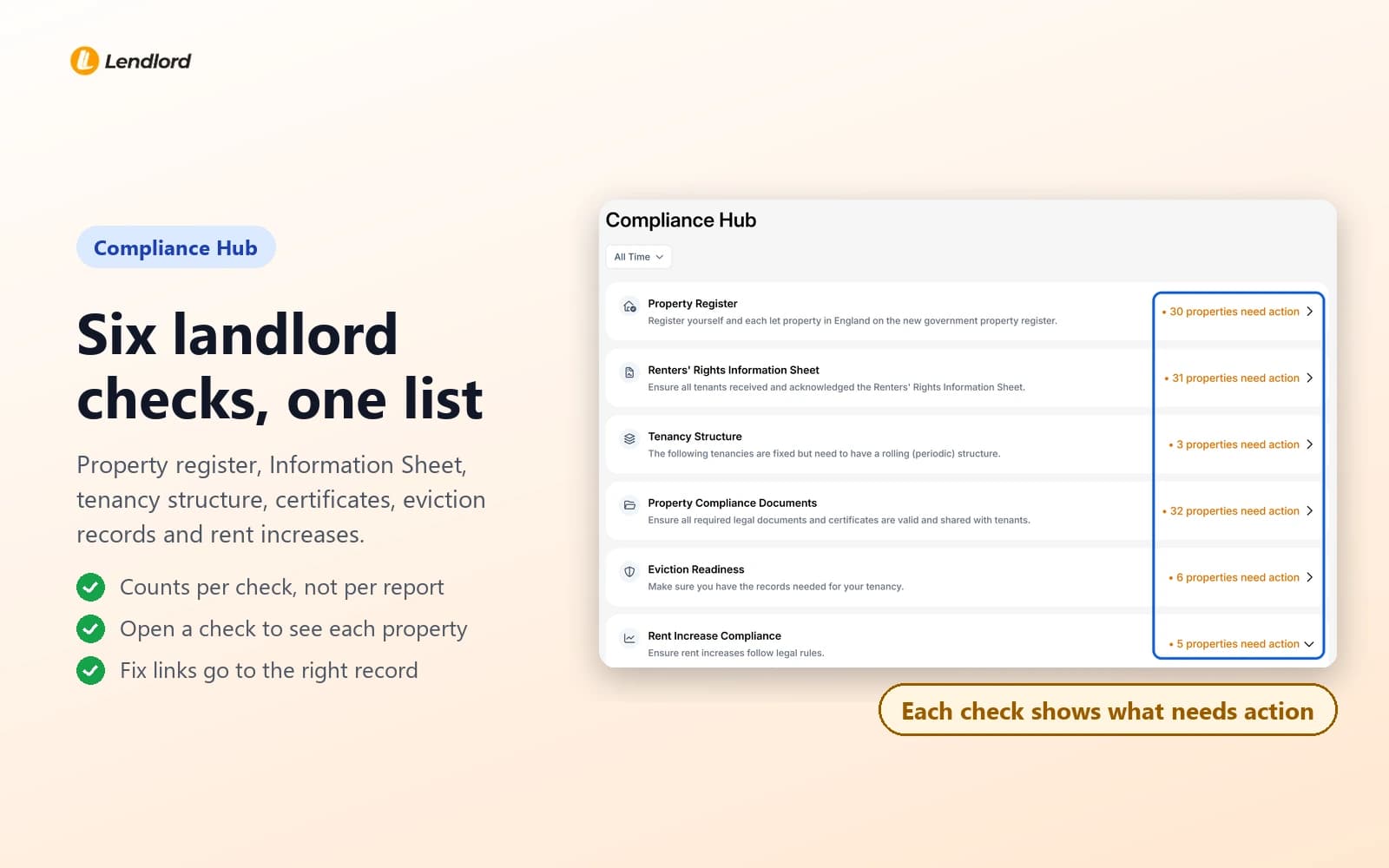
A reminder only helps once the expiry date is stored on the home.
Alerts once a certificate date is stored
Beside the English Housing Survey
The English Housing Survey chapter was published on 29 January 2026 and covers England. In 2024 its private rented stock was 48% at C, 37% at D, 9% at E and 3% at A or B. The current minimum in that chapter is E.
The English Housing Survey models a weighted sample of every private rented home in England. Lendlord counts the certificate band a landlord entered, and only where one was entered. Read the two columns as two pictures.
| Band | English Housing Survey | Recorded on Lendlord |
|---|---|---|
| A or B | 3% | 9.3% |
| C | 48% | 44.4% |
| D | 37% | 37.0% |
| E | 9% | 8.7% |
Source: the English Housing Survey chapter cited below, and the Lendlord snapshot. That chapter covers England.
Five things to do before 2030
Work through the homes you already let. An installer prices the works. A solicitor can say whether an exemption fits. You still start with the certificate.
Two homes at D
Take four homes, two at C and two at D. The cap confirmed for the 2030 standard is £10,000 per home. From 1 October 2030 the two at D sit against at most £20,000. That figure is the cap, not a quote. If the works would cost more, ask whether an exemption applies.
Before 2030
- Look up each home on the energy certificate register guide.
- Record the band and the expiry date against the home.
- List the D homes first. Most homes below C are one band short.
- Price the works against the £10,000 maximum required investment confirmed for 2030, and note where an exemption would apply.
- Read ways to pay for the works before you book them. For a block of upgrades, see short-term finance for a block of upgrades.
Check your own homes
- Every home has its current band and expiry date written down.
- Each home below C is listed with its band.
- Each of those homes has a quote or estimate set against the £10,000 cap that applies from 2030.
- The exemption route is checked where the works would cost more than the cap.
- Certificates that expire before 1 October 2030 are in the diary.
How to read these figures.
These are certificate bands landlords entered.
The homes sit in England and Wales, on accounts approved for disclosure, as at 31 October 2026. A band is recorded on 26.7% of let homes. Shares are of that subset, not of every let home. Landlords who record a band may differ from those who do not.
The file is a rating record, not a check of the building. With band A left out, because the September export counts an old form default as A, the share below C was 49.3% in September and 48.1% in October. That is a similar share a month earlier, not a trend.
A recorded expiry date had already passed on 2.8% of let homes. Many homes have no expiry date stored, so that share is only a prompt to check the date. The figures describe landlords on Lendlord, not the whole UK private rented sector.

Expert insight from Aviram Shahar, Co-Founder and CEO of Lendlord. PropTech entrepreneur. Last updated November 2026. Know the band, then price the step from D to C. The certificate, the £10,000 cap that applies from 2030 and the D homes are the plan.
Official data sources
- GOV.UK, Energy Independence Bill factsheet, domestic private rented enforcement (4 November 2026)
- GOV.UK, improving the energy performance of privately rented homes, 2025 update (response 21 January 2026)
- GOV.UK, minimum energy efficiency standard: landlord guidance (updated 5 May 2026)
- GOV.UK, English Housing Survey 2024 to 2025, chapter 2 (29 January 2026)
- GOV.UK, find an energy certificate
Record the bands before you price the works
Put the certificate and the expiry date on each home. Then the D homes are a list you can cost.
Check the certificates on your homes