UK Landlords Face a £26.5 Billion Refurbishment Bill. Can AI Help You Budget Smarter?
Published · Updated · 8 min read
If you own rental property in England, you already know costs are heading in one direction. But what you might not realise is just how fast the regulatory landscape is shifting, and how much it could end up costing you if you're not prepared.
I've spent the last few weeks digging through government data, and honestly? The numbers caught me off guard. Between tougher energy rules, a revamped Decent Homes Standard, and construction costs that refuse to sit still, landlords across the country are staring down a refurbishment bill that runs into the billions. Let me walk you through what's actually happening, what it means for your portfolio, and how smart investors are using technology to stay ahead of the curve.
New EPC Rules Are Coming, and the Fines Are No Joke
The government confirmed in its 2025 consultation on energy efficiency in privately rented homes that the minimum EPC rating for rental properties will rise to Band C by 2030. Right now, the minimum sits at Band E. That's a significant jump.
And if you think you can just ignore it and carry on? Think again. Landlords who fail to bring their properties up to scratch face fines of up to £30,000 per property. Not per portfolio. Per property. If you've got three non-compliant rentals, that's potentially £90,000 in penalties before you've even picked up a paintbrush.
There is a cost cap of £10,000 per property for required energy improvements, which limits how much a landlord must spend out of pocket. But even with that cap, the expense adds up quickly when you multiply it across a portfolio of five, ten, or twenty units.
"The government will increase the maximum civil penalty to £30,000 for each breach of the PRS minimum energy efficiency standards."
- GOV.UK, Improving the energy performance of privately rented homes: Government response
Analyse Any Deal in Minutes, Not Weeks
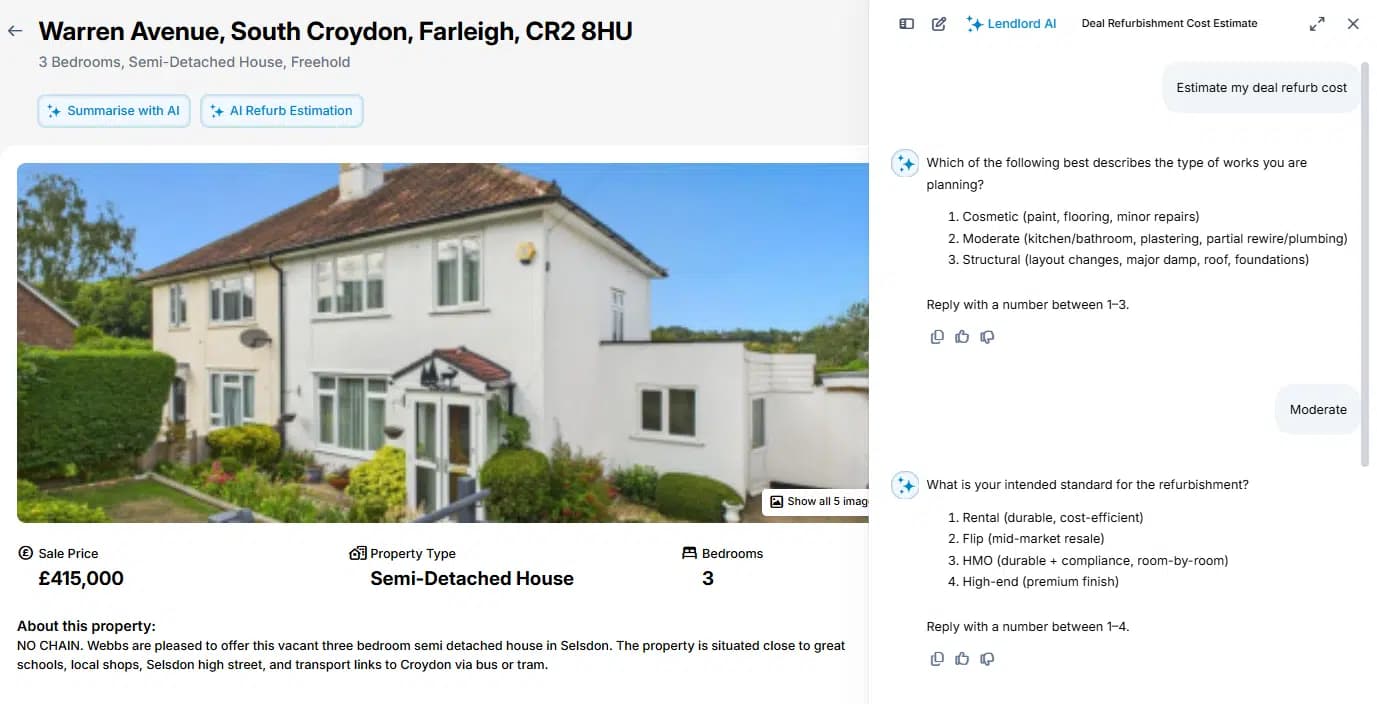
Whether you're browsing listings or bidding at auction, Lendlord's AI gives you instant refurb estimates so you never overpay for a property again.
The State of Private Rented Housing: A Reality Check
Let's look at what the government's own research tells us about the condition of rental properties right now. According to the English Housing Survey 2024 to 2025, the picture isn't great:
- 15% of private rented homes fail the Decent Homes Standard
- 10% of private rented dwellings have damp problems, which is more than double the rate found in owner-occupied properties
- Around 9 to 10% of private rented homes contain Category 1 hazards under the Housing Health and Safety Rating System
Those aren't small numbers. If you own a buy-to-let that hasn't been updated in a while, there's a genuine chance it falls into one of those categories. And with local authorities getting sharper enforcement powers, turning a blind eye is becoming riskier by the year.
So How Much Will All This Actually Cost?
Here's where it gets properly eye-watering. The English Housing Survey energy efficiency data estimates that the average cost to bring a property up to EPC Band C is £7,480. Scale that across the entire private rented sector, and you arrive at a total of roughly £26.5 billion.
On top of that, the proposed revised Decent Homes Standard would require a median spend of £5,240 on every property that currently falls short. So some landlords could be looking at well over £12,000 per unit just to tick the regulatory boxes.
| Compliance Area | Estimated Cost Per Property | Source |
|---|---|---|
| EPC upgrade to Band C | £7,480 (average) | English Housing Survey 2024-25 |
| Revised Decent Homes Standard | £5,240 (median) | EHS Briefing: Modelling a New Decent Homes Standard |
| Non-compliance fine (max) | Up to £30,000 | GOV.UK Consultation Response |
Construction Costs Keep Climbing. Your Budget Needs to Keep Up.
Even if you have a rough idea of what your refurbishment will cost, there's another factor working against you: inflation. Construction materials and labour aren't getting cheaper any time soon.
The ONS Interim Construction Output Price Indices show that construction output prices have been rising at approximately 2.5% year-on-year. That might sound modest, but do the maths on a £40,000 refurbishment and you're looking at an extra £1,000 or more in costs if works slip by just twelve months.
For landlords buying at auction, where speed is everything, this creates a real problem. You spot a property, you need to work out whether the deal stacks up after refurb costs, and you need that answer fast. Waiting three weeks for a builder to come round and give you a quote isn't an option when the hammer falls in five days.
The Old Way of Estimating Refurb Costs Is Broken
Be honest with yourself for a moment. How do you currently estimate refurbishment costs? If you're like most landlords I talk to, it's some combination of:
- A spreadsheet you put together years ago that hasn't been updated since
- A rough figure based on "what the last one cost" (ignoring that was two years and several price hikes ago)
- Waiting for contractor quotes that take weeks to arrive
- Asking around on property forums and hoping for the best
None of that is good enough when you're making decisions about properties worth hundreds of thousands of pounds. And with regulatory deadlines tightening and construction costs climbing, the margin for error has never been thinner.
How AI Is Changing the Game for Property Investors
This is the part I actually get excited about. Because while the regulatory picture looks pretty demanding, the tools available to landlords have genuinely improved.
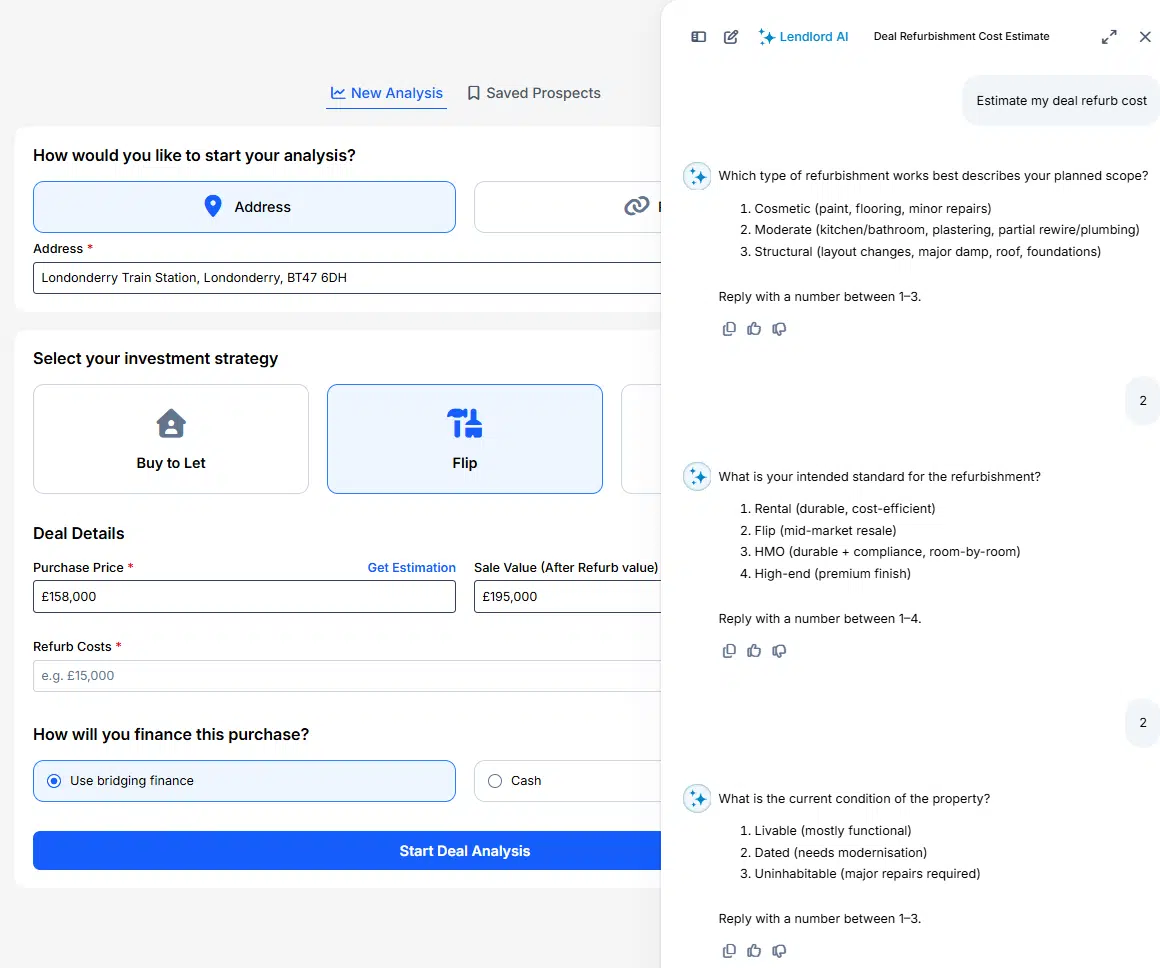
Lendlord's AI Refurb Estimation is built directly into its property deal analyser. You don't need to download anything extra or sign up for a separate service. It works like this:
- Find a property you're interested in, whether that's on Rightmove, Zoopla, at auction, or anywhere else
- Click "AI Refurb Estimation" inside the Lendlord deal analyser
- Answer a few questions about the property's current condition and what level of refurbishment you're considering (cosmetic, moderate, or structural)
- Get an itemised cost breakdown aligned with current market rates, delivered in seconds
But here's what really sets it apart from a static calculator or a generic online tool: you can keep the conversation going. Want to know what happens if you skip the loft conversion? Ask it. Curious whether swapping a full kitchen replacement for a cosmetic refresh changes the numbers enough to make the deal work? Just type the question.
It's like having a quantity surveyor on speed dial, available 24/7, who never gets annoyed when you change your mind for the fifth time.
See It in Action: AI Refurb Estimation Walkthrough
Watch how Lendlord's AI Refurb Estimation tool works in practice. From selecting a property to getting a full cost breakdown in seconds.
A Real-World Example: Does This Deal Stack Up?
Let me paint a picture that might feel familiar. You've found a three-bedroom semi-detached in South London listed at £415,000. The property has a current EPC rating of D and needs a moderate refurbishment. The question you need answered: does the deal work after refurb costs?
With Lendlord's AI, you run the numbers in under a minute:
| Refurb Item | Estimated Cost |
|---|---|
| Kitchen replacement | £8,500 |
| Bathroom refurbishment | £4,200 |
| Full redecoration (3 beds, living room, hallway) | £5,800 |
| New boiler and heating upgrades (EPC improvement) | £3,900 |
| Flooring throughout | £3,100 |
| Electrical rewire (partial) | £2,800 |
| Total Estimated Refurb | £28,300 |
Now you ask the AI: "What if I keep the existing kitchen and just replace the worktops and doors?" The estimate drops by £5,000. Suddenly the numbers look different. That's the kind of scenario testing that used to take days of back-and-forth with contractors, done in about thirty seconds.
Why Getting Refurb Costs Right Matters More Than Ever
I know what some of you are thinking. "I've been doing this for years, I can eyeball a refurb cost." And sure, experience counts for a lot. But the landscape has shifted in ways that make gut feeling less reliable than it used to be.
Consider this:
- Regulatory deadlines are fixed. The 2030 EPC Band C requirement isn't a suggestion. It's law. If your property isn't compliant by then, you can't legally let it out (with very limited exceptions).
- Construction inflation is real. The ONS data shows costs rising consistently. What cost £35,000 eighteen months ago could easily cost £37,000 today.
- Category 1 hazards carry serious consequences. The English Housing Survey found that 9 to 10% of private rented homes contain Category 1 hazards. Local councils can issue improvement notices, prohibition orders, or emergency remedial action orders for these.
- The competition is getting smarter. Investors who can make faster, better-informed decisions on acquisition and refurb costs are winning the best deals. Especially at auction.
Make Smarter Property Decisions Today
Join thousands of UK landlords and property investors who use Lendlord to analyse deals, estimate refurb costs, and manage their portfolios in one place.
What Smart Landlords Are Doing Right Now
The landlords who will come through the next five years in the strongest position aren't the ones with the biggest budgets. They're the ones making the best decisions, fastest. Here's what that looks like in practice:
1. Getting Ahead of Compliance Deadlines
Rather than waiting until 2029 to panic about EPC Band C, they're assessing their portfolios now. Which properties need work? How much will it cost? Which ones should they sell instead of upgrade? These are questions worth answering today, not the night before the deadline.
2. Using Technology to Move Faster
At auction, you might have five working days between viewing a property and placing your bid. That's not enough time for traditional contractor quotes. AI-powered estimation tools let you run the numbers on a property while you're still standing in the hallway.
3. Stress-Testing Every Deal Before Committing
The ability to adjust refurb scope and instantly see how it affects your overall return is something that simply wasn't available to individual investors until recently. It's the kind of analysis that used to require a paid quantity surveyor or a very experienced project manager.
The Bottom Line
The government data doesn't leave much room for interpretation. The private rented sector needs to invest billions in property upgrades over the coming years. Fines for non-compliance are steep. Construction costs are rising. And the landlords who can accurately estimate refurbishment costs before committing capital will make better acquisitions and avoid nasty surprises down the line.
AI won't replace the need for a proper survey before you exchange contracts. But it can replace the guesswork that happens in those critical early stages when you're deciding whether a deal is even worth pursuing. And in a market where good deals disappear in days, not weeks, that speed advantage is worth having.
Ready to See What Your Next Refurb Will Actually Cost?
Lendlord's AI Refurb Estimation is free to try. No credit card required. Just pick a property and get your cost breakdown in seconds.
Start Your Free Account →Official Sources
- GOV.UK - Improving the energy performance of privately rented homes: Government response (2025)
- GOV.UK - English Housing Survey 2024 to 2025: Headline findings on housing quality and energy efficiency
- GOV.UK - English Housing Survey 2024-25: Chapter 2 Energy Efficiency
- GOV.UK - EHS Briefing: Modelling a New Decent Homes Standard
- ONS - Interim Construction Output Price Indices
This article is for informational purposes only and does not constitute financial or investment advice. Property investment carries risks. Always conduct your own due diligence and consult qualified professionals before making investment decisions.